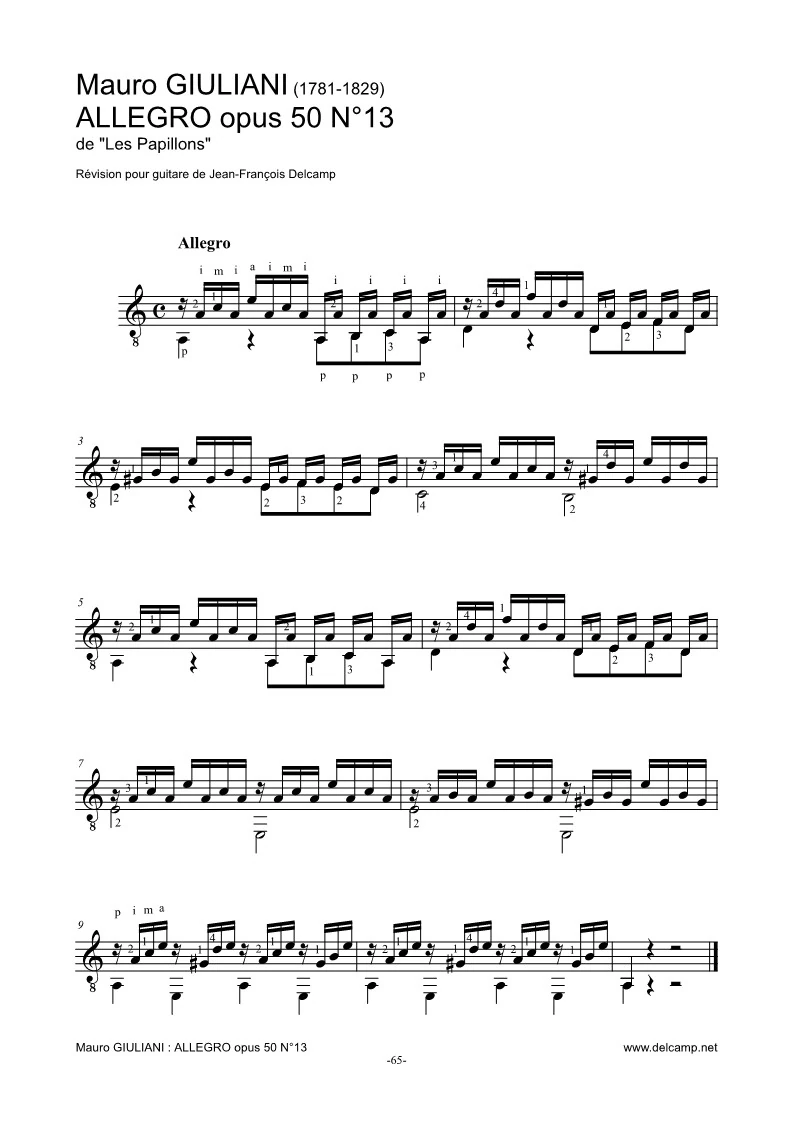
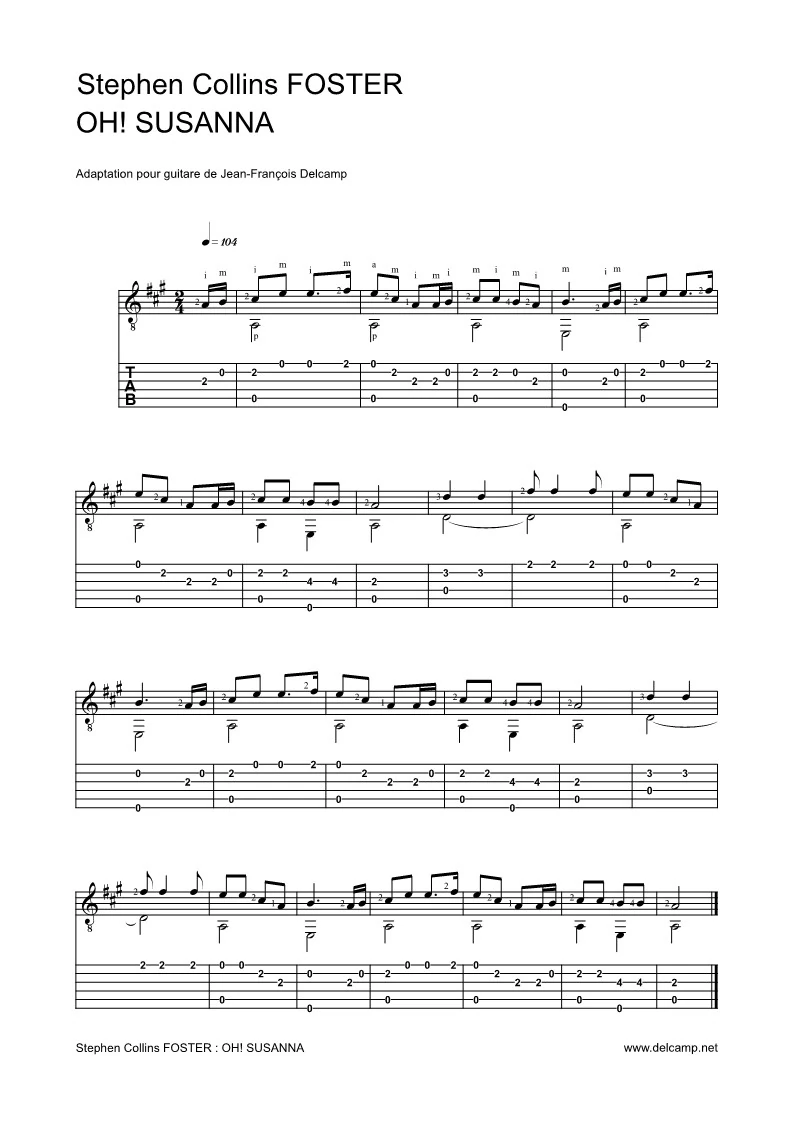
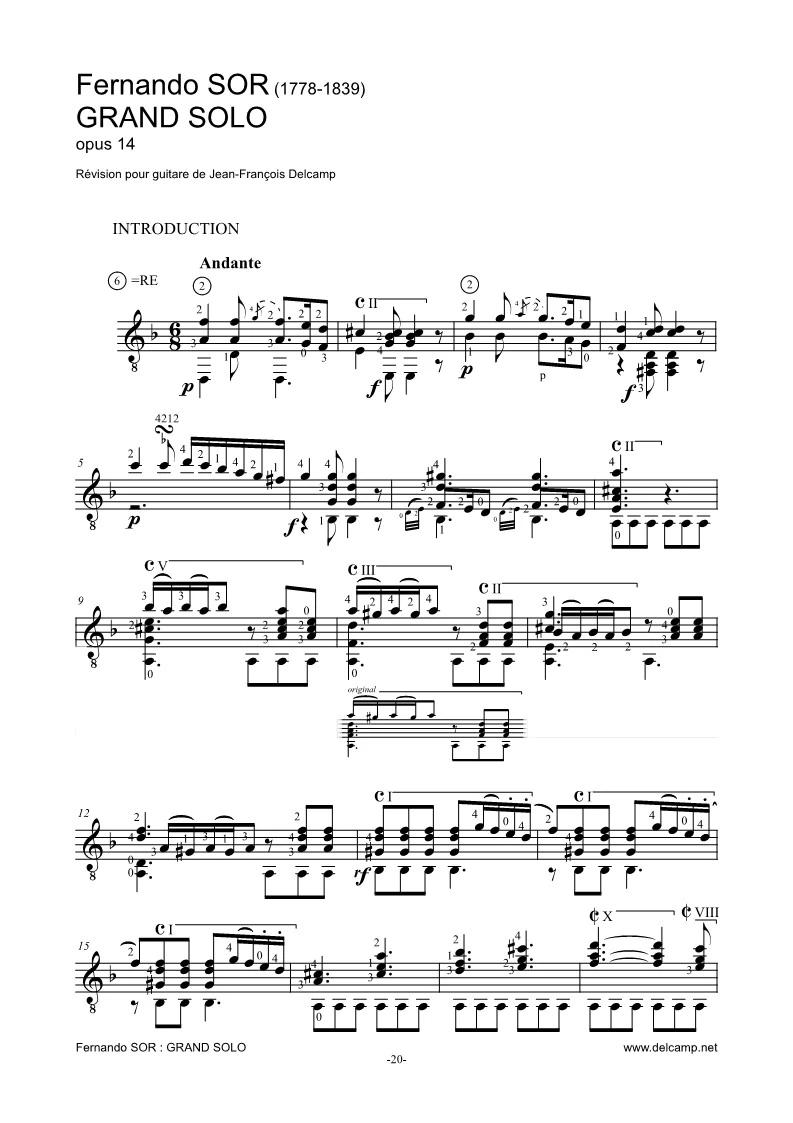
This website offers a comprehensive catalog of free sheet music in PDF format: 36,387 pages of scores are available, including 5,893 pages of tablature. The catalog covers a broad historical period, from the Renaissance to the present day, and includes works by major composers.
The sheet music and tablature are available for download as PDFs, making them easy to read and print. The site does not offer a paid version of these works, making it a valuable resource for students, teachers, and amateur musicians. The pieces cover a range of difficulty levels, providing something for everyone from beginners to advanced guitarists.
Among the available resources, you will find around a hundred classical guitar methods, collections of works classified by level of difficulty, as well as masterpieces from the Renaissance, Baroque, Classical, Romantic, and Modern periods. You will also find Spanish and South American music, Christmas carols, and contemporary music. And then there are all of Bach’s works for solo lute, as well as works by composers such as Sagreras, Barrios, Giuliani, Tárrega, Sanz, Carulli, Sor, Albéniz, Weiss, Dowland, Granados, Scarlatti, Llobet, and many others.
If you encounter difficulties and wish to learn a new piece or technique, you will find help on Delcamp’s forums. These forums offer archives of previous online courses, as well as support workshops in three languages: English, Italian and French. A new session of free online courses for beginners who don’t have access to a teacher will begin in September 2026.
Jean-François Delcamp, the author of this site, is a guitarist, editor, and composer. He has received several first prizes in international guitar competitions (Milan, 1981 and Paris, U.F.A.M., 1981). He holds the Certificate of Aptitude for Guitar Teaching awarded by the French Ministry of Culture. After a 40-year career as a guitar teacher at the Brest Regional National Conservatory (France), Mr. Delcamp retired, finding time to compose new works and publish new editions for guitar.
In summary, Classical-guitar-sheet-music.com is a reliable and comprehensive source for obtaining free classical guitar sheet music, with a catalogue rich in historical and contemporary works.
On September 1, 2026, the 2026-2027 session of new classical guitar courses for level 1 (beginner, grade 1) will begin on the English-language forum: https://www.classicalguitardelcamp.com/. If you don’t speak English, use online automatic translators; they are now reliable.
These courses will be based on a method that, like all my publications, will be free. This method, in PDF format, is currently being written and will be released in early August 2026.
The requirements to participate in these courses are:
You must publish your YouTube videos of the course program between the 1st and 8th of the month. Starting on the 9th of the month, I and the forum members will comment on your work to help you improve. You will then be asked to submit a new video recording demonstrating that you are able to apply the advice given. These free courses are designed for isolated amateurs who don’t have the opportunity to learn guitar.
Students must ensure that their videos consistently show the full vibrating length of their guitar strings (from the nut to the bridge). Videos must be filmed in a fixed shot, without camera movement. The faces of the participants can be visible, masked, blurred, or hidden. You can participate in the courses using your real name or a pseudonym.
If you are fortunate enough to have a guitar teacher, you can attend these courses as an auditor, but you cannot submit your recordings.
The schedule for each monthly course, running from September to June, will be announced the month before.
Looking forward to hearing from you.
– Grades 1 to 4, sheet music and tabs for beginners – 1,030 pages
– Grades 5 to 8, intermediate classical guitar sheet music – 796 pages
– Grades 9 to 12, advanced classical guitar sheet music – 678 pages
– Classical guitar methods – 7,201 pages
– Tablatures for classical guitar – 5,893 pages
– Renaissance music for classical guitar – 202 pages
– Luys Milán – Arrangements for guitar – 40 pages
– Alonso Mudarra – Complete Guitar Works – 28 pages
– Adrian Le Roy – Complete Guitar Works – 68 pages
– Luys de Narváez – Arrangements for guitar – 14 pages
– Guillaume Morlaye – Complete Guitar Works – 244 pages
– John Dowland – Arrangements for guitar – 29 pages
– Baroque music for classical guitar – 260 pages
– Gaspar Sanz – Complete Guitar Works – 118 pages
– Jan Antonín Logy – Guitar Works – 118 pages
– Robert de Visée – Guitar Works – 164 pages
– Johann Pachelbel – Arrangement for guitar – 3 pages
– François Couperin – Arrangement for guitar – 10 pages
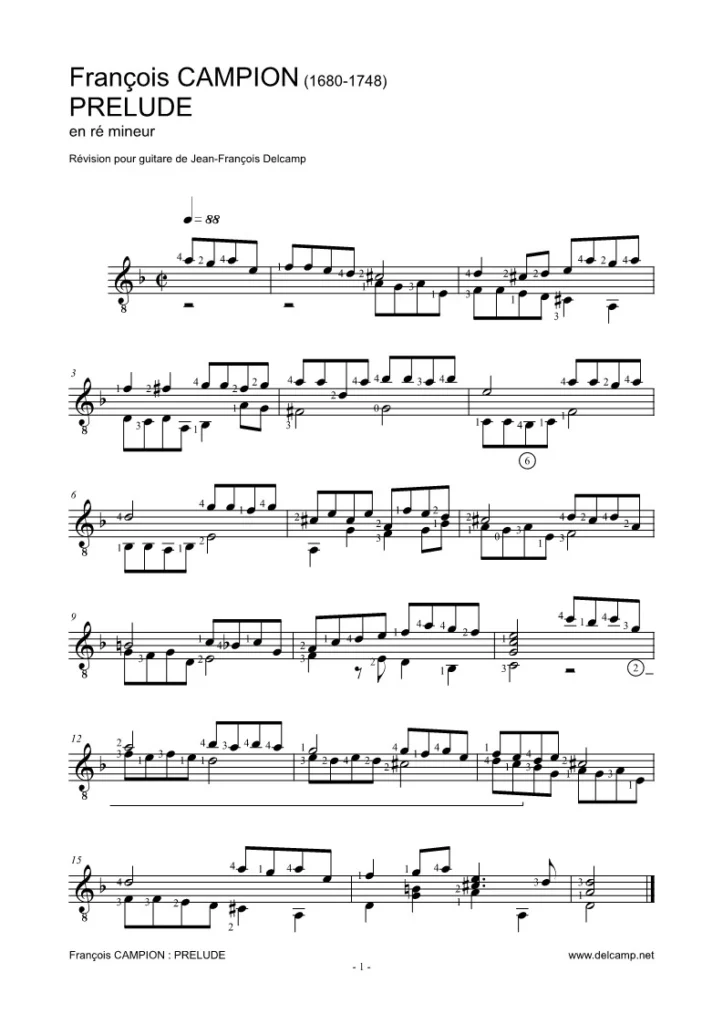
– François Campion – Guitar Works – 7 pages
– Jean-Philippe Rameau – Arrangements for guitar – 32 pages
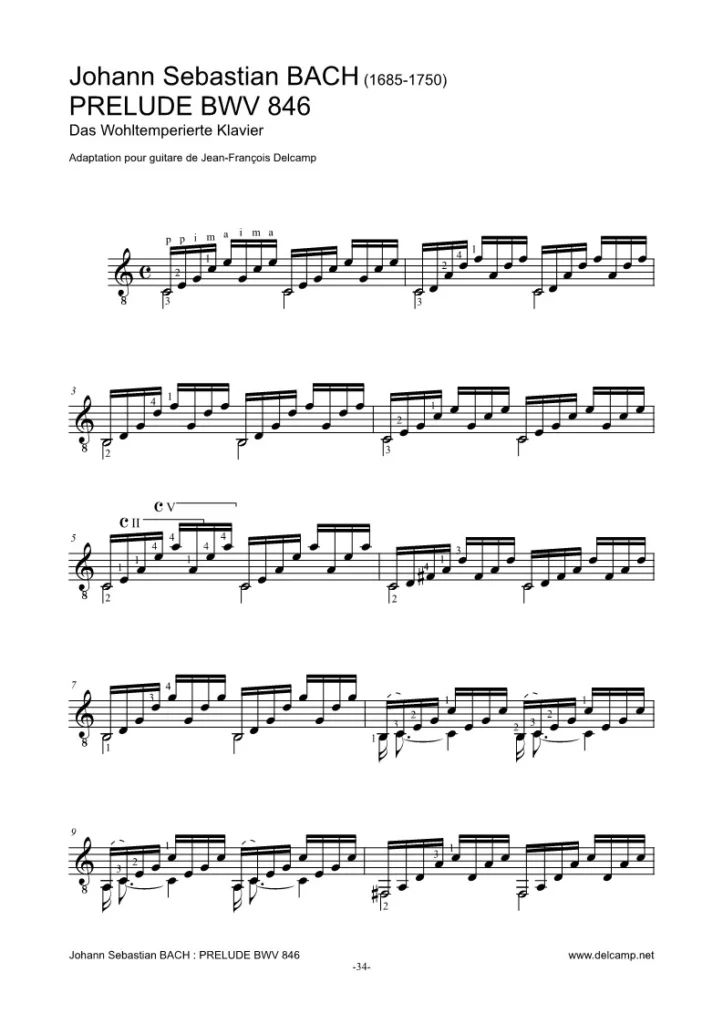
– Johann Sebastian Bach – Lute Suites and arrangements for guitar – 448 pages
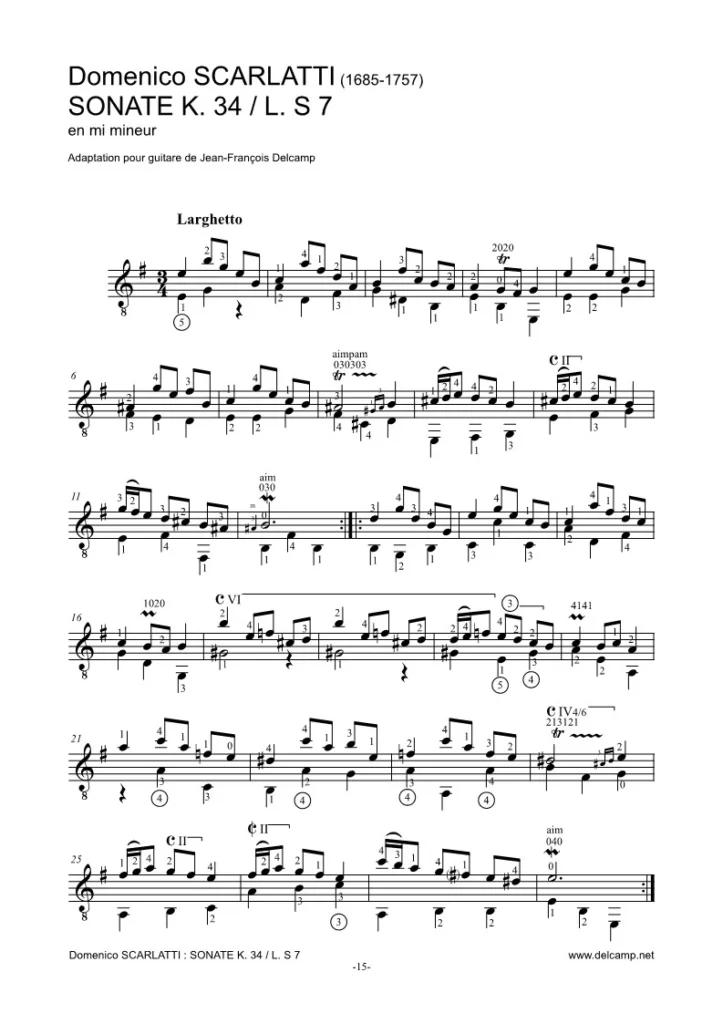
– Domenico Scarlatti – Arrangements for guitar – 56 pages
– Georg Friedrich Handel – Arrangements for guitar – 21 pages
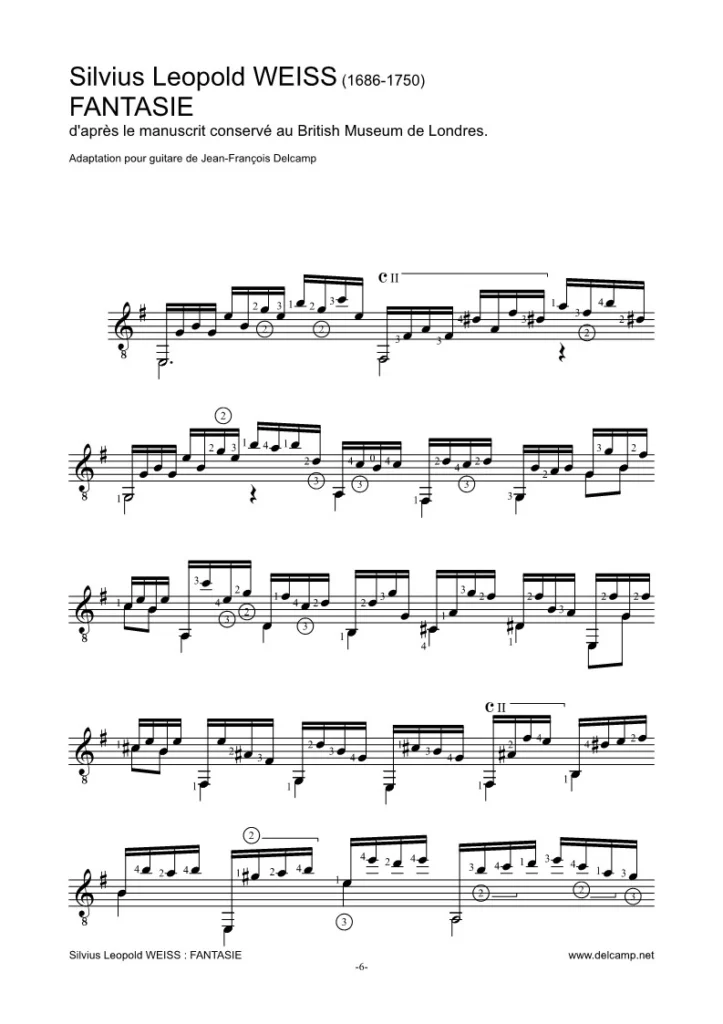
– Silvius Leopold Weiss – Arrangements for guitar – 535 pages
– 19th century guitarists – Guitar Works – 1,423 pages
– Classical masterpieces for classical guitar – 536 pages
– Ferdinando Carulli – Guitar Works – 2,117 pages
– Wenzeslaus Matiegka – Guitar Works – 194 pages
– Joseph Küffner – Guitar Works – 774 pages
– Fernando Sor – Complete Guitar Works – 1,260 pages
– Mauro Giuliani – Guitar Works – 1,739 pages
– Anton Diabelli – Guitar Works – 381 pages
– Niccolò Paganini – Guitar Works – 138 pages
– Dionisio Aguado – Guitar Works – 512 pages
– Matteo Carcassi – Guitar Works – 776 pages
– Napoléon Coste – Guitar Works – 447 pages
– Johann Kaspar Mertz – Guitar Works – 1069 pages
– Giulio Regondi – Guitar Works – 50 pages
– Spanish guitar – Fortea, Tolsa, Viñas, Brocá, Cimadevilla, Sirera – 43 pages
– Julián Arcas – Complete Guitar Works – 202 pages
– José Ferrer y Esteve – Guitar Works – 328 pages
– Francisco Tárrega – Complete Guitar Works – 242 pages
– Isaac Albéniz – Arrangements for guitar – 162 pages
– Antonio Jiménez Manjón – Complete Guitar Works – 349 pages
– Enrique Granados – Arrangements for guitar – 110 pages
– Ernest Shand – Guitar Works – 158 pages
– Spanish Music for Guitar – 1012 pages
– Latin American Music for Guitar – 1242 pages
– Women composers – Guitar Works – 353 pages
– Christmas Carols for Classical Guitar – 18 pages
– Albert John Weidt – Complete Works for Solo Guitar – 88 pages
– Luigi Mozzani – Guitar Works – 81 pages
– Manuel de Falla – Work and Arrangements for Guitar – 14 pages
– Miguel Llobet Solés – Complete Guitar Works – 202 pages
– Julio Sagreras – Guitar Works – 860 pages
– Joaquin Turina – Complete Guitar Works – 80 pages
– João Pernambuco – Guitar Works – 25 pages
– Agustín Barrios Mangoré – Guitar Works – 137 pages
– Ñico Rojas – Guitar Works – 42 pages
– Elisabeth Calvet – Guitar Works – 92 pages
– Jean-François Delcamp – Guitar Works – 380 pages
– Duets, trios, quartets for classicals guitars – 1,012 pages
Rules: This competition, aimed at intermediate-level amateurs, takes place online on the “Classical Guitar Forum”. The 3 compulsory pieces are by Jean-François Delcamp. The competition comprises three phases running from February 1 to February 28, 2027. In each phase, candidates publish their YouTube video of a compulsory piece. Adult guitarists of all nationalities, registered on the Classical Guitar Forum, can take part in the competition. Guitarists who have already won a prize in the International Guitar Competition are not eligible to enter a second time.
Registration: If you haven’t already done so, register for the English-language forum , then request your registration for the next competition session by posting a message in reply to this thread. Registration is free. Registration for the competition closes on January 31, 2027 . If there are fewer than 20 registrants by the close of registration on January 31, 2027, the competition will be postponed to the following year, with the same program, so that the candidates’ investment is not lost. Write your registration message for the next competition as follows: “Hello everyone, I’m an adult and I’m entering the 2027 session of the Delcamp International Guitar Competition. Candidates for the eliminatory and semi-final rounds may register on the forum under a pseudonym, or under their real first and last names. If one of the contest entrants changes his or her mind and withdraws from the contest, I ask him or her to let me know. So that, on January 31, 2027, I have the exact number of registrants to validate, or postpone, the organization of the next competition session. On February 20, all finalists must, if necessary, accept their username change in order to display their real first and last names as forum members. If a finalist refuses to display their real first and last names, they will not be able to compete in the final.
How to record YouTube videos of the competition’s compulsory pieces: Candidates must ensure that their videos show the full vibrating length of their guitar strings (from the nut to the bridge). The videos must be filmed in a fixed shot, with no camera movement. For the first two rounds (eliminatory and semi-final), candidates’ faces may be visible, masked, blurred or hidden. For the final, the candidates’ faces must be visible, as well as the full vibrating length of their guitar strings. If the framing hides, permanently or momentarily, part of the vibrating length of the strings, the video is invalidated. YouTube videos entered in the competition must be public, visible to all. Private or unlisted videos will not be accepted. Only recordings made from the editions indicated are accepted. Transposed versions, or recordings made from other editions, will be invalidated. Tempos and fingerings are free.
The 3 compulsory pieces: Download the PDF of the 3 compulsory pieces , in two versions: on staves and on tablature.
Elimination rounds : Candidates must publish their video of the compulsory piece during a 72-hour period, between February 1 at 0:00 GMT and February 3 at 24:00 GMT. For the elimination round, each contestant must post on the contest’s English-language forum a message containing the link to the URL of their YouTube video, preceded by the words: “Hello everyone, here’s my YouTube video recording, showing the full vibrating length of my guitar strings. My video recording is made without any tricks or editing.” The following piece is to be recorded for the eliminatory: J. F. Delcamp : Prélude n°1 opus 4 . The results of this eliminatory will be published on February 10.
Semi-final : Candidates must publish their video of the compulsory piece during a 72-hour period, between February 10 at 0:00 GMT and February 12 at 24:00 GMT. For the semi-final, each contestant must post a message on the contest forum containing the link to the URL of their YouTube video, preceded by the words: “Hello everyone, here is my YouTube video recording, showing the full vibrating length of my guitar strings. My recording is made without any tricks or editing.” The following piece is to be recorded for the semi-final: J. F. Delcamp : Tango en la mineur opus 3 . The results of this semi-final will be published on February 19.
Final : Candidates must publish their video of the compulsory piece during a 72-hour period, between February 20 at 0:00 GMT and February 22 at 24:00 GMT). For the final, each contestant must post a message on the contest forum containing links to the URLs of his or her YouTube videos, preceded by this formula: “Hello everyone, my name is …………… …………, here is my YouTube video recording, showing the full vibrating length of my guitar strings. My face is visible. My recording is made without any tricks or editing.” The following piece is to be recorded for the final: J. F. Delcamp : Isabelle opus 23. The results of this final will be published on February 28. The three winners guarantee that their 3 competition videos will remain public on their YouTube channel for a period of 3 years. Failing that, Jean-François Delcamp will post a copy of the winning videos on his own YouTube channel, where they will no longer be public.
Prizes awarded to the 3 contest winners
The competition jury is chaired by Jean-François Delcamp. The jury’s decisions are final. The three prizes awarded are: 1st prize €500 – 2nd prize €300 – 3rd prize €200. The jury does not award tied prizes. The prizes will be paid to the winners by bank transfer after the winners have sent the administrator a private message including their IBAN (International Bank Account Number), or any other reference enabling them to receive a bank transfer from France. For one year, the 3 contest winners will be featured on the 3 forums: French-speaking forum , Italian-speaking forum , English-speaking forum .
1st Prize: Monika Schulz
2nd Prize: Mr. Jacob Kelsey
3rd Prize: Mr. Pascal Leroy

1st Prize: Mr. Victor Fouriaud
2nd Prize: Mr. Kristian Nøhr
3rd Prize: Mr. Edgar Blanc
3rd Prize: Mr. Fiderana Andriniaina
© Delcamp documents’ terms of use
Scores, online guitar lessons, audio and/or video documents found on classical-guitar-sheet-music.com are free and royalty free and may be used for non-commercial and individual purpose. You are not authorized to distribute one or more copies of any of the above mentioned, in native or converted format.
https://www.classicalguitardelcamp.com/
Conditions d’utilisation des documents de Delcamp
Les partitions, cours de guitare en ligne, enregistrements audio et vidéo de classical-guitar-sheet-music.com sont gratuits et libres de droits pour une utilisation individuelle et non commerciale. Vous n’êtes pas autorisé à redistribuer des copies des documents, ni dans le format proposé, ni après conversion dans un autre format.
https://www.guitareclassiquedelcamp.com/
Condizioni per utilizzare i documenti di Delcamp :
Spartiti, corsi di chitarra on line, registrazioni audio e video di classical-guitar-sheet-music.com sono gratuiti e liberi di diritti per un uso individuale e non commerciale. Non siete autorizzati a ridistribuire copie dei documenti, sia nel formato proposto sia dopo conversione in altro formato.
https://www.chitarraclassicadelcamp.com/
Condiciones de uso de los documentos de Delcamp:
Las partituras, los cursos de guitarra en línea y las grabaciones audio y vídeo de classical-guitar-sheet-music.com son gratuitos y están libres de derechos para uso individual y no comercial. No estás autorizado a redistribuir copias de los documentos, ni en el formato ofrecido ni previa conversión a otro formato.
https://www.guitarraclasicadelcamp.com/
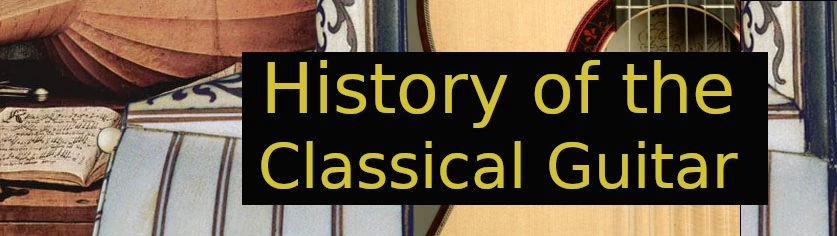
Music of the Renaissance for classical guitar
(1536 to 1637)
In 1501, in Venice, the printer Ottavio Petrucci was the first to use typography in the production of music. The pages were printed in three stages: first, the staves, then the notes and finally the text and the page numbers. This new process replaced the old practice of handwritten scores and, for the first time, the very rich lute repertory could be widely disseminated.
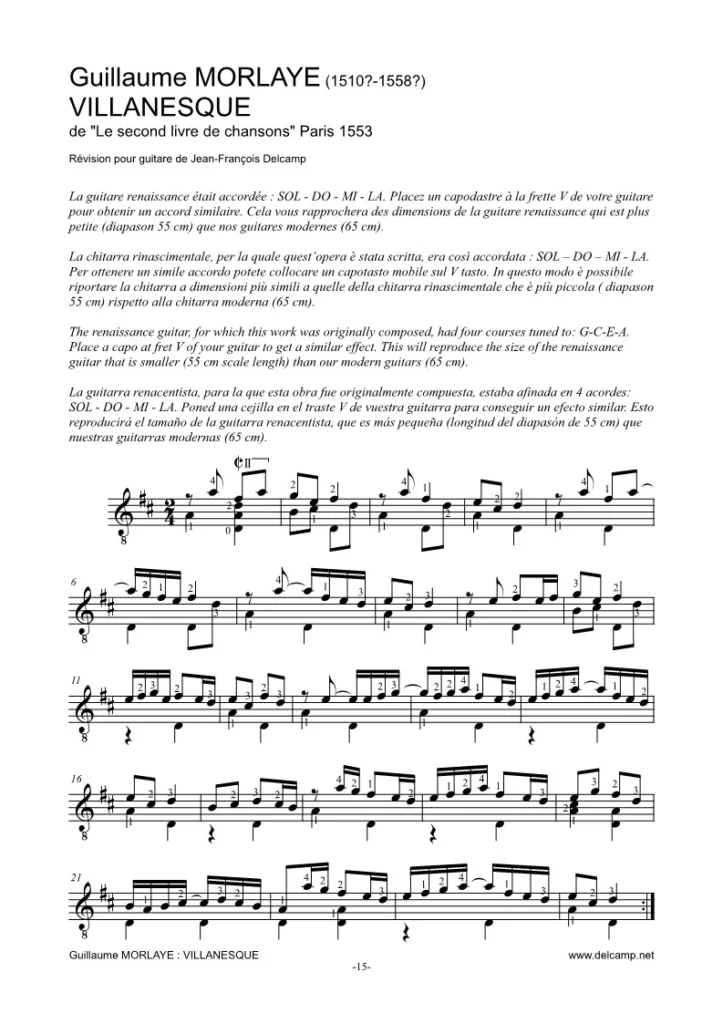
In 1536, that is to say a hundred years after the appearance of printing in Europe, Luys Milán, a gentleman at the court of the king of Portugal and of the Islands, published in Valencia, under the title of El Maestro, a collection of music which contains instrumental pieces for vihuela, as well as songs with vihuela accompaniment. Two years later, in 1538, Luys de Narváez published in Valladolid “Los seys libros del Delphin de musica” which introduced into Spain the idea of Variations on a Theme. In 1546 “Tres Libros de Musica para Vihuela” by Alonso Mudarra appeared in Seville. In the third book are published for the first time small pieces written for the four string guitar.
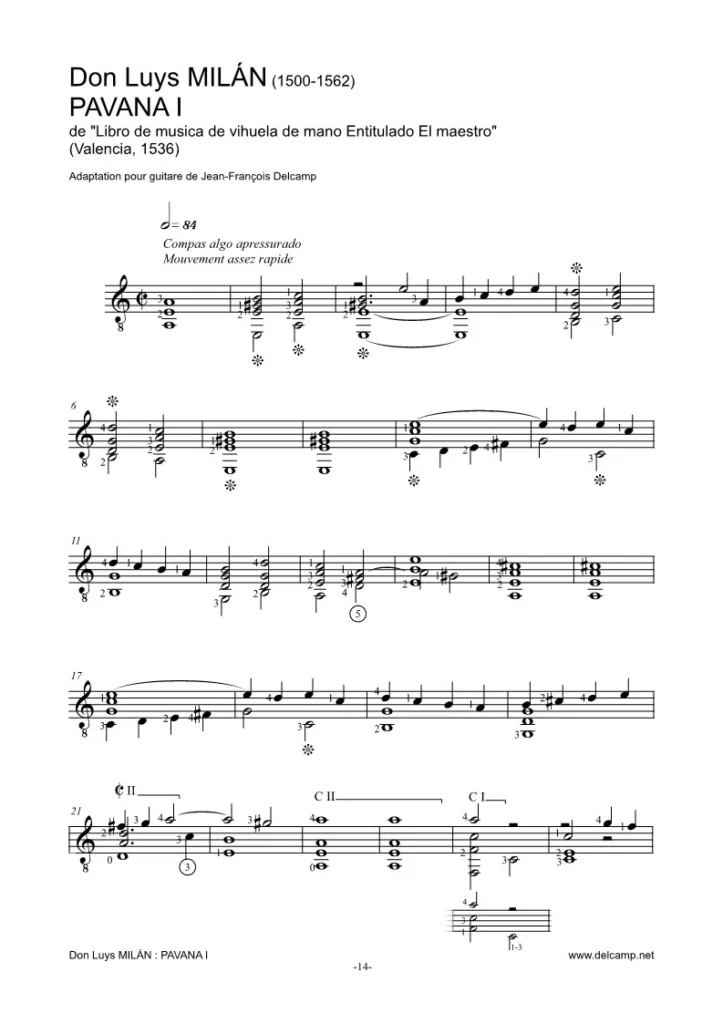
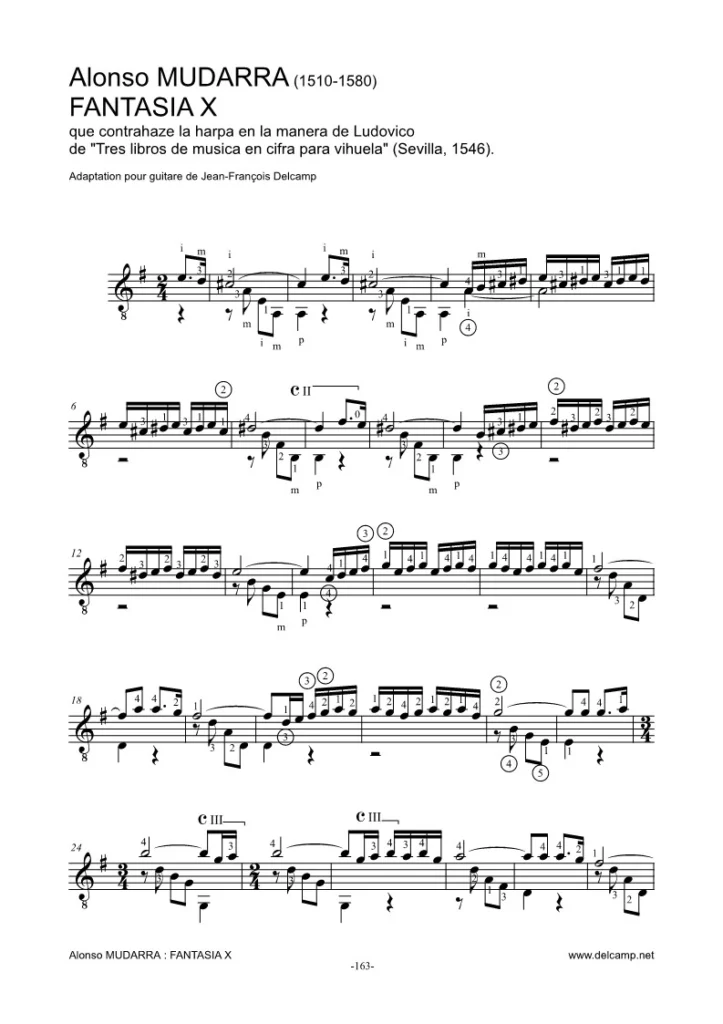
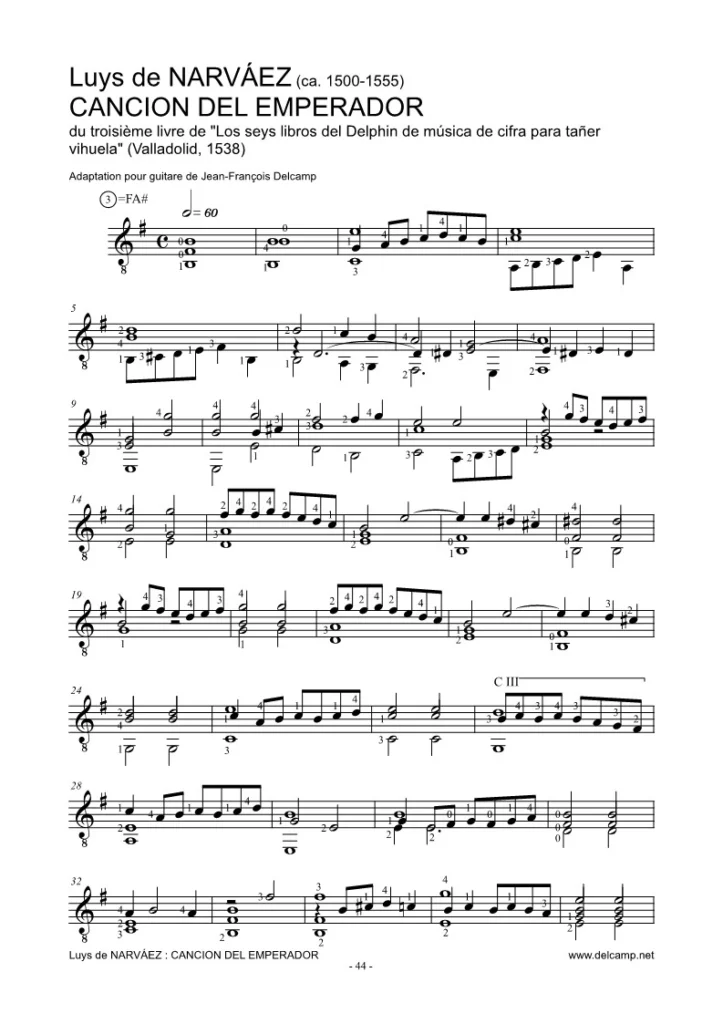
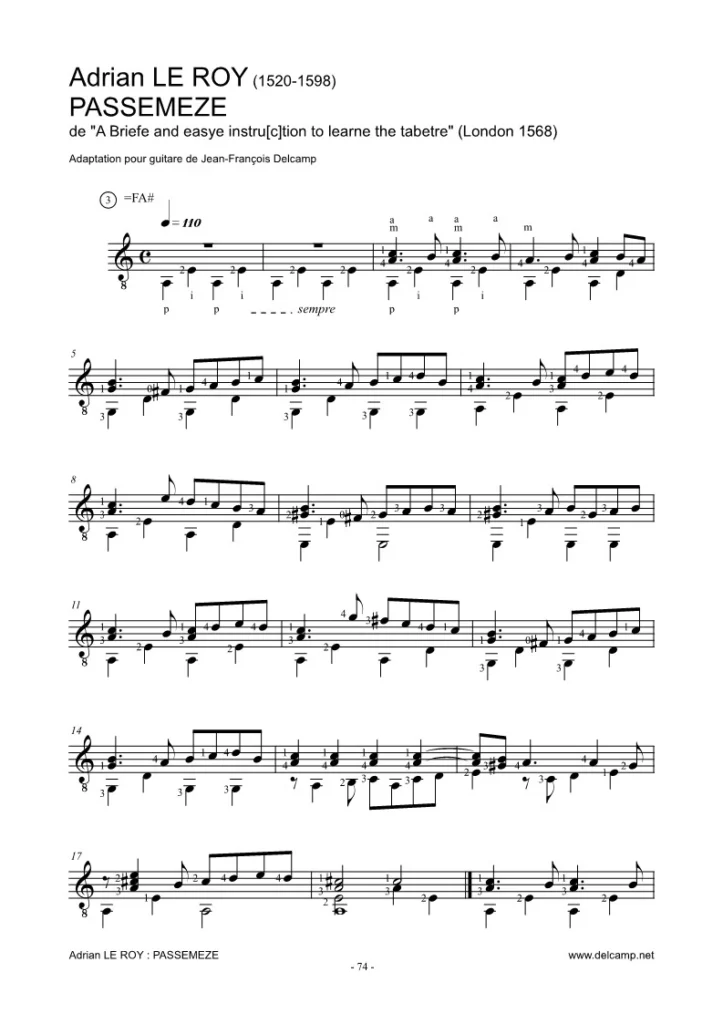
During the sixteenth century, a score of books for guitar were published, mainly in Paris. In 1549 Adrian Le Roy, together with his cousin, Robert Ballard, founded an important publishing house which was given the royal seal of approval. Between 1551 and 1556 they published 5 books of guitar tablatures.
Round about 1570, the sonority and register of the guitar were increased with the addition of a fifth string. This innovation, together with the introduction of the flat back from about 1650, heralded the birth of the “Spanish guitar”.
Baroque Music for classical guitar (1670 to 1750)
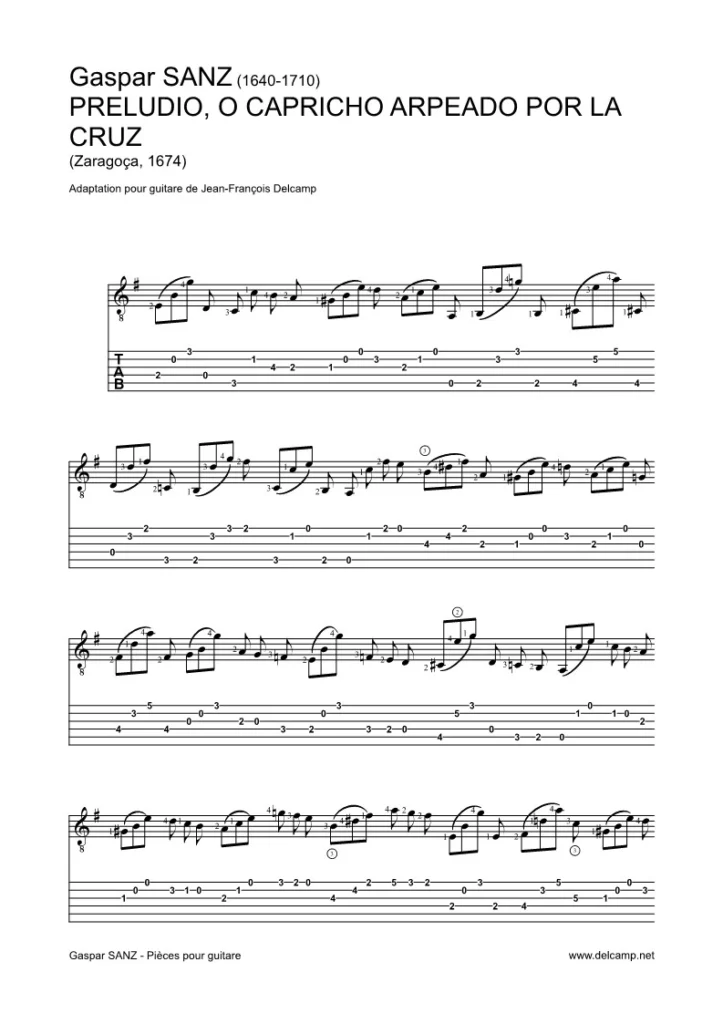
In 1674, the Spaniard Gaspar Sanz published his “Instruccion de musica sobre la guitarra española”.
In France, in 1670, Francesco Corbetta printed in Paris “la guitarre Royalle“.
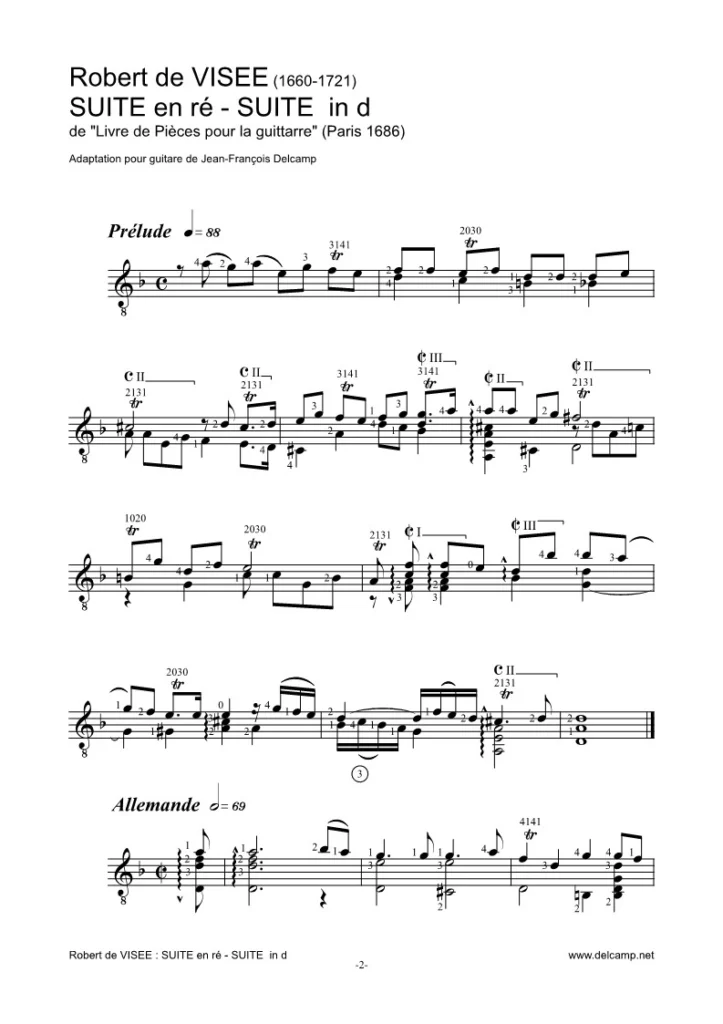
Robert de Visée, successor of Francesco Corbetta as musician at the court of the King of France, had his “Livre de guittarre dédié au Roy” printed in Paris (1682).
In 1703, François Campion was given the title of professor of theorbo and guitar at the Royal Academy of Paris by king Louis XIV. He published his “Nouvelles Découvertes sur la guitare” in Paris in 1705 as well as a treaty on accompaniment which includes the first fugues for guitar ever written.
In 1692 the Italian Ludovico Roncalli published his “Capricci armonici sopra le chitarra spagnola“.
In addition, works for the baroque lute from Johann Sebastian Bach and Sylvius Léopold Weiss and the many sonatas for harpsichord of Domenico Scarlatti adapt marvelously well to the guitar.
Classical period music for classical guitar (1750 to 1840)
During this time the Italian guitarists travelled through all of Europe. Paris, Vienna and London accommodated these musicians in turn.
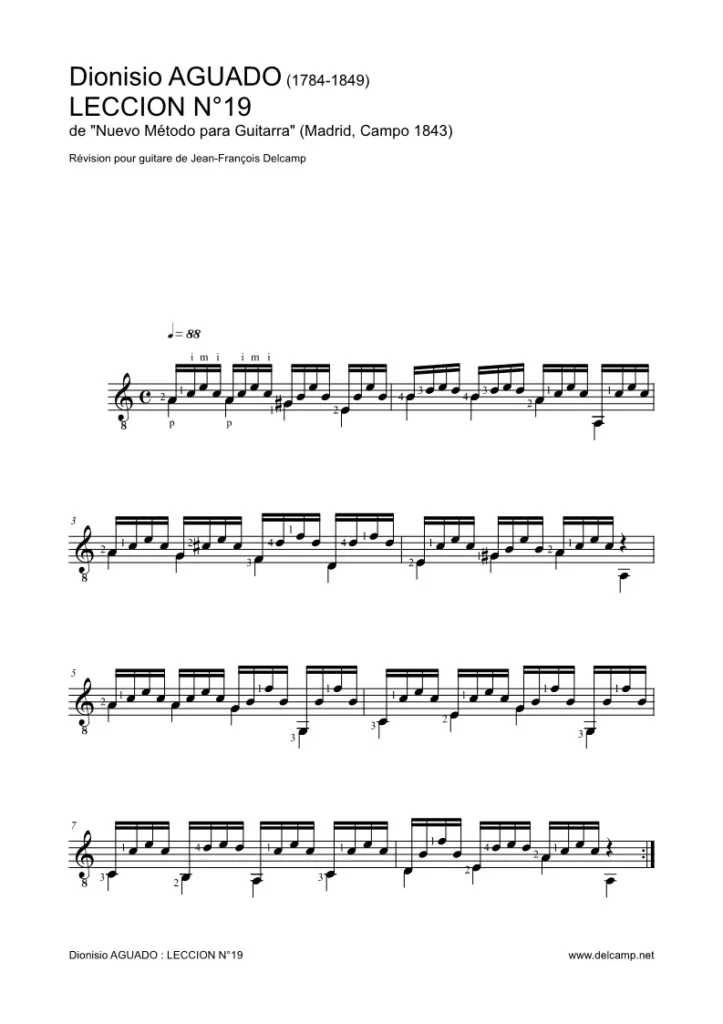
From 1800 to 1820, the Italian virtuoso Mauro Giuliani (1780-1840), composed the first concertos for guitar and orchestra in Vienna. The Austrian capital also had excellent guitarists such as Wenzeslaus Thomas Matiegka (1773-1830), Anton Diabelli (1781-1858) and Leonhard von Call (1768-1815).
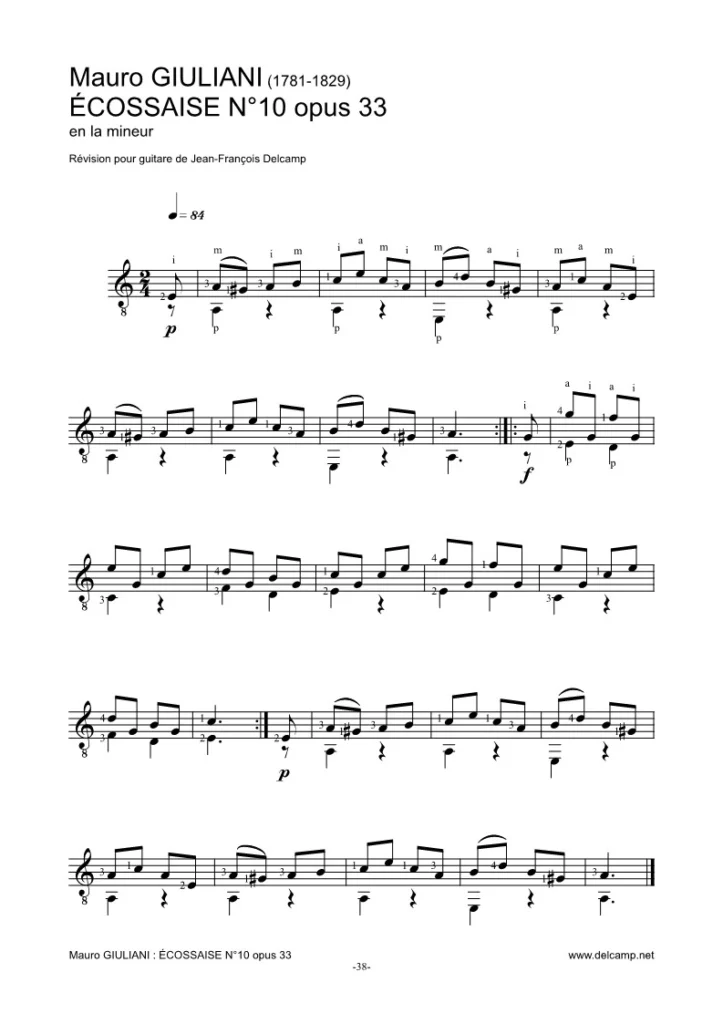
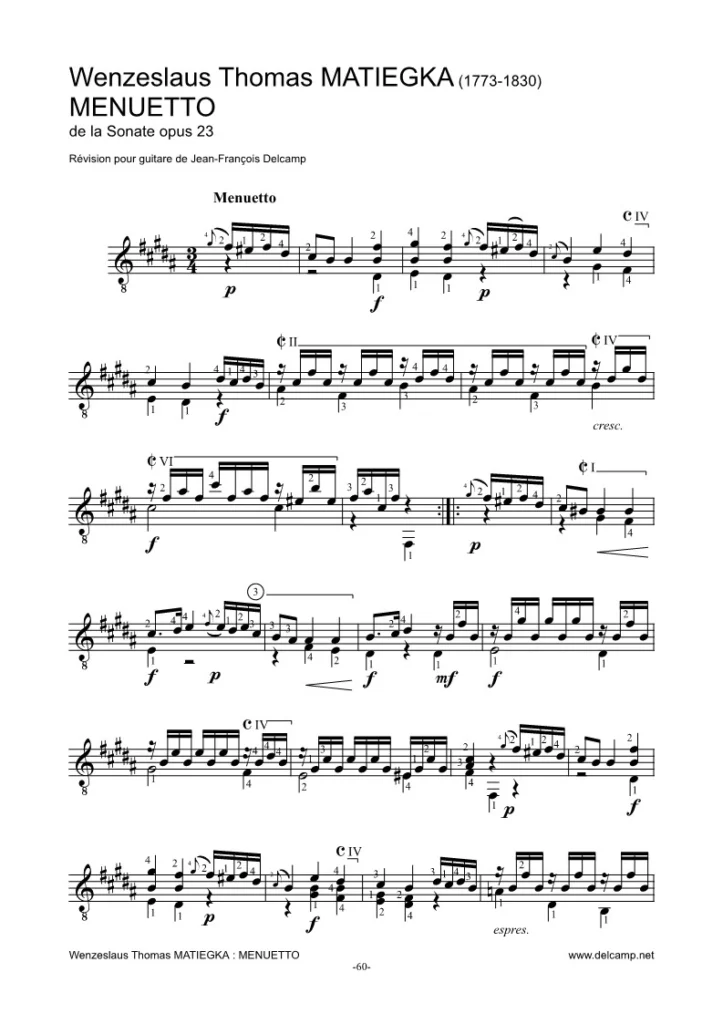
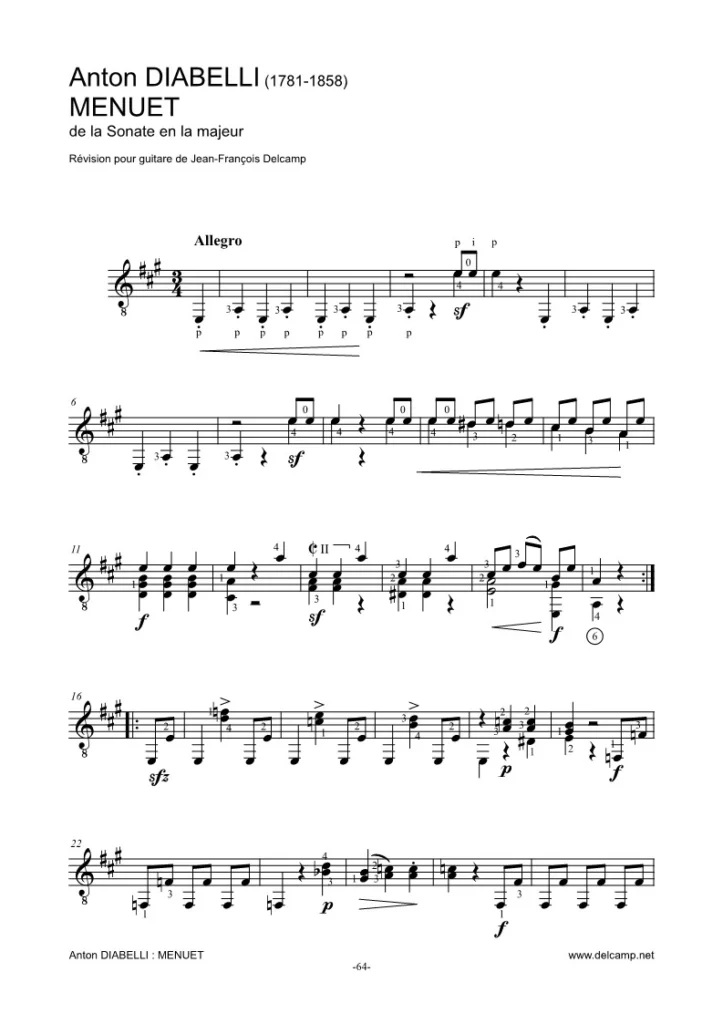
From 1810 to 1840, Paris became the principal home of the guitar. Virtuosos like the Italians Matteo Carcassi (1792-1853) and Ferdinando Carulli (1770-1841) settled there, as well as the Spaniards Dionisio Aguado (1784-1849) and Fernando Sor (1778-1839).
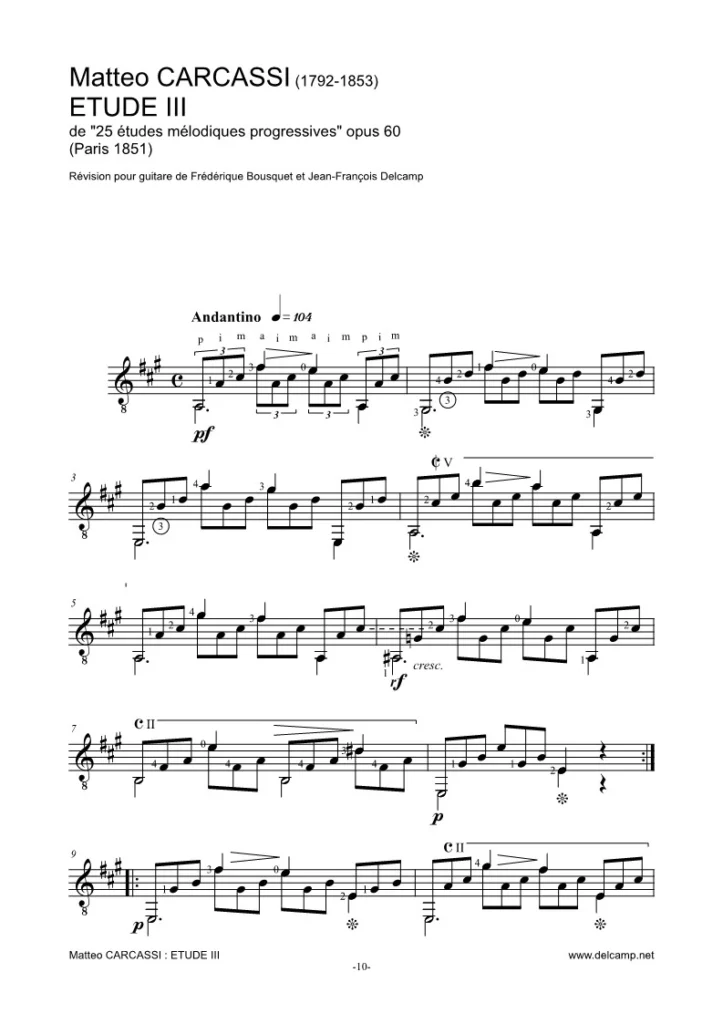
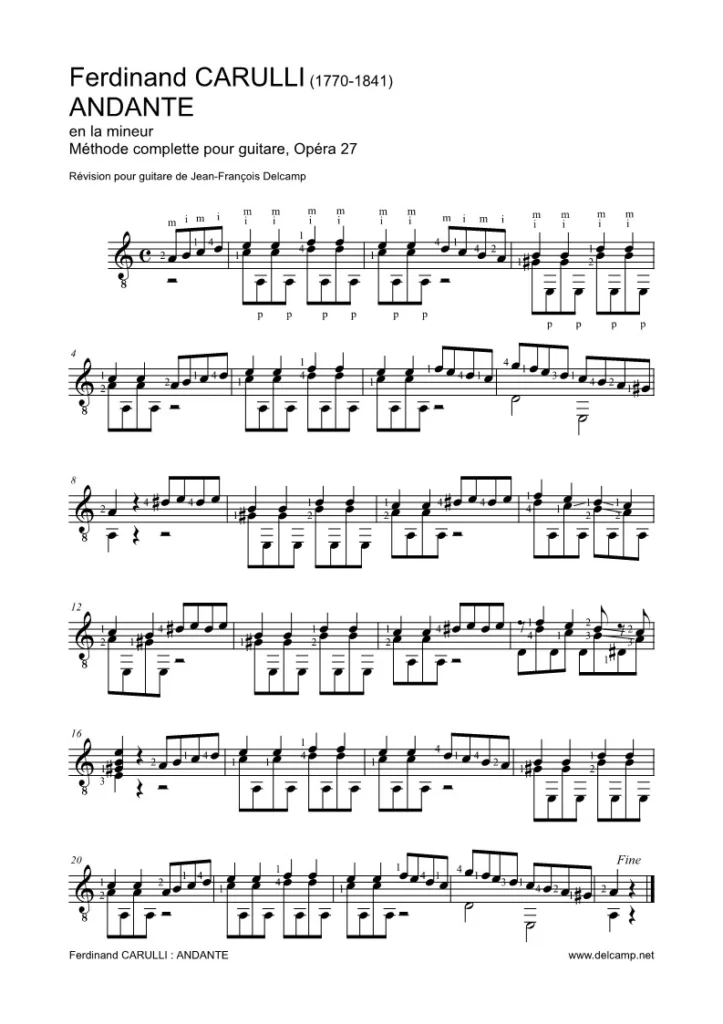
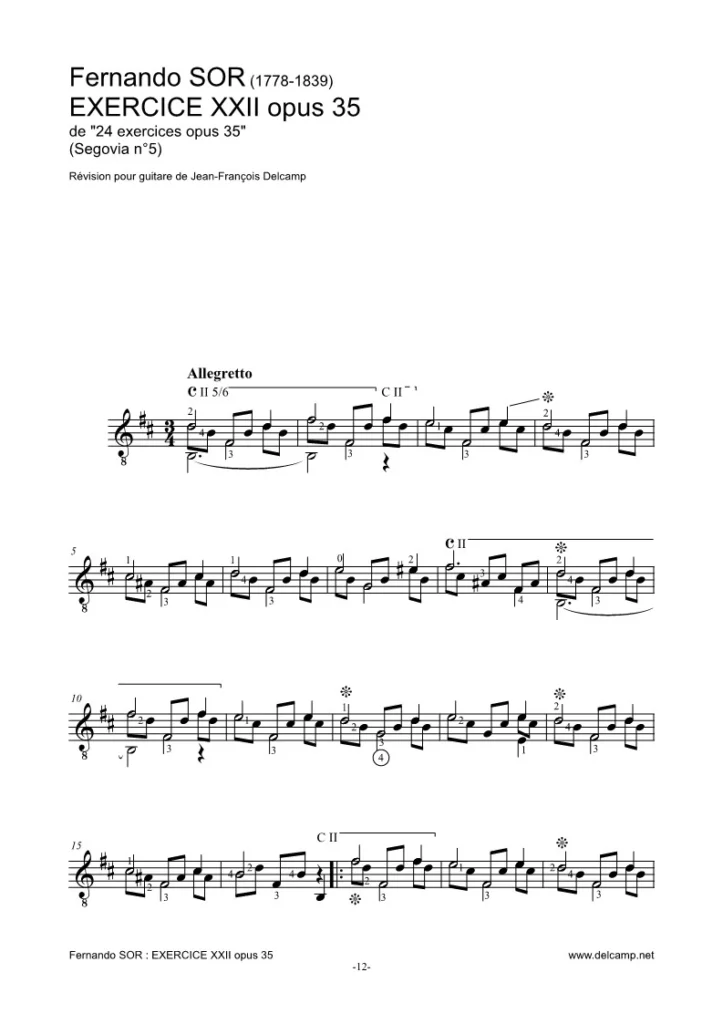
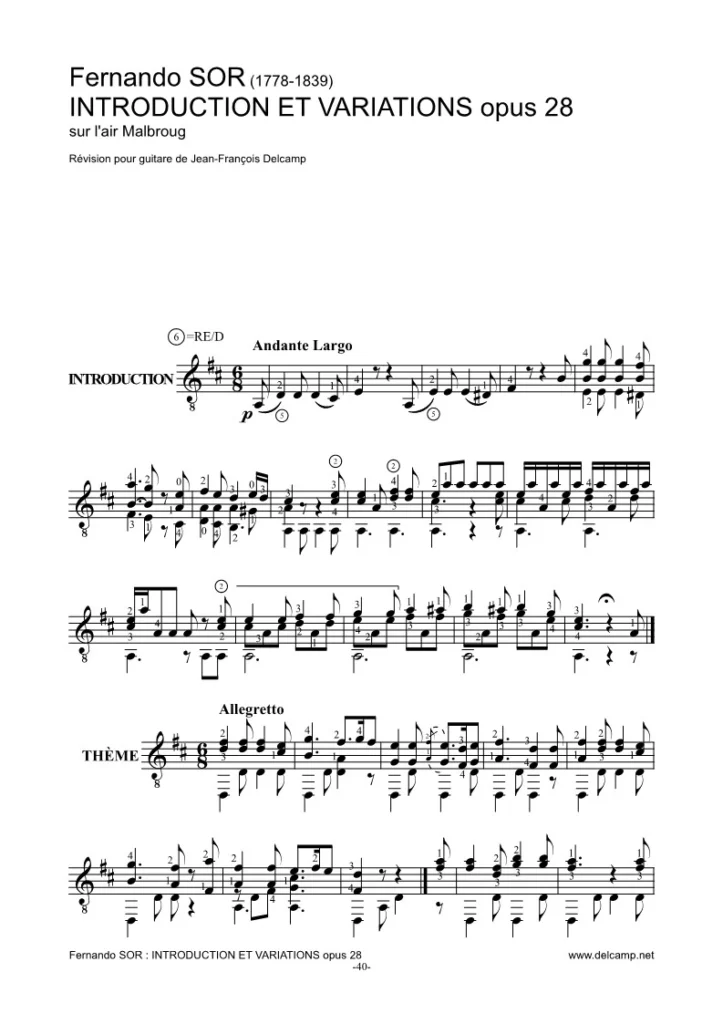
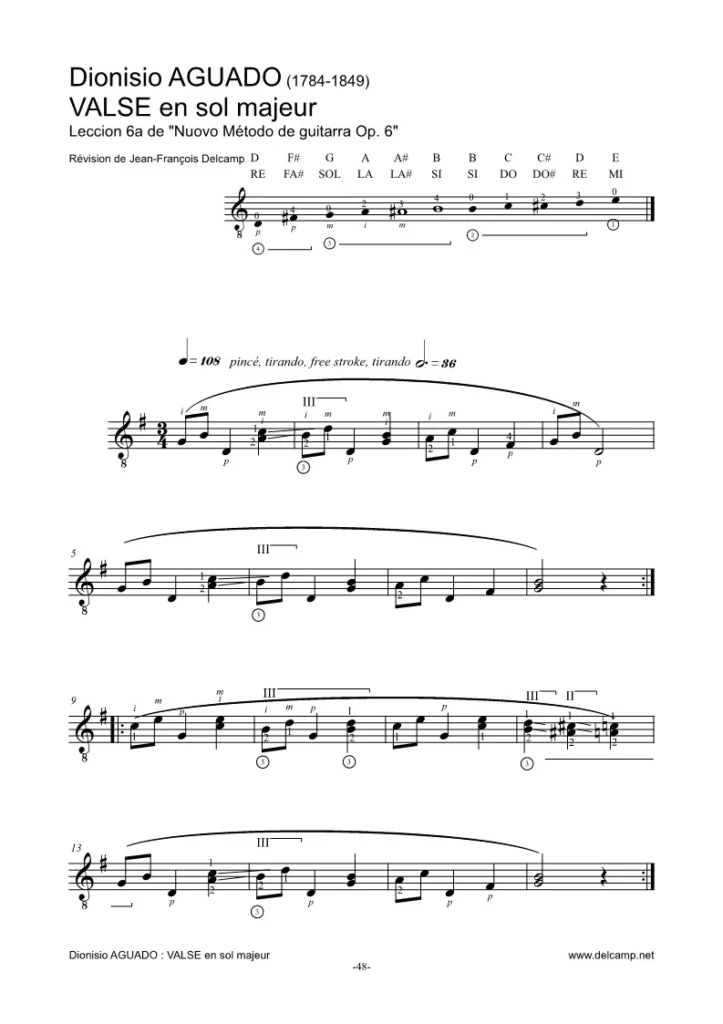
Romantic Music for classical guitar (1840 to 1920)
Guitarists travelled widely in Europe and Latin America.
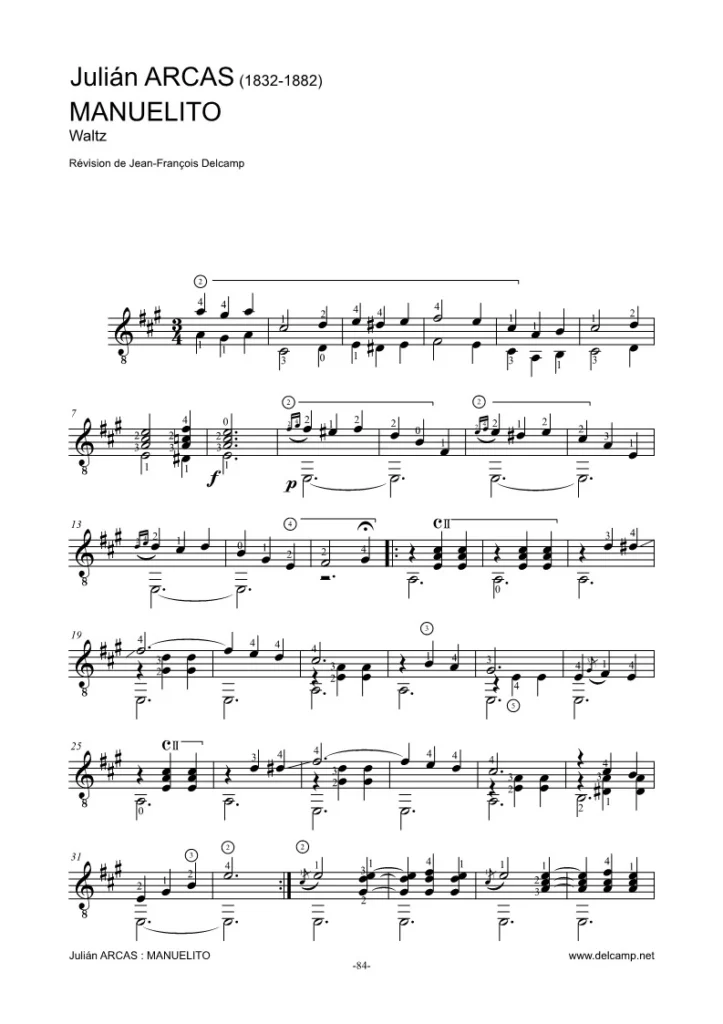
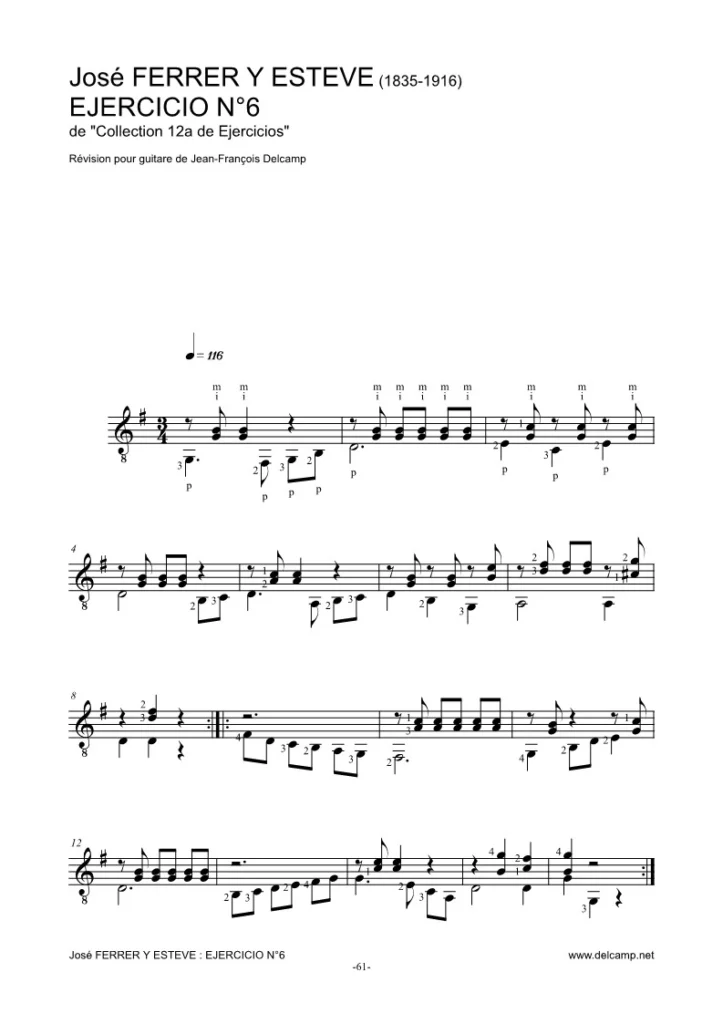
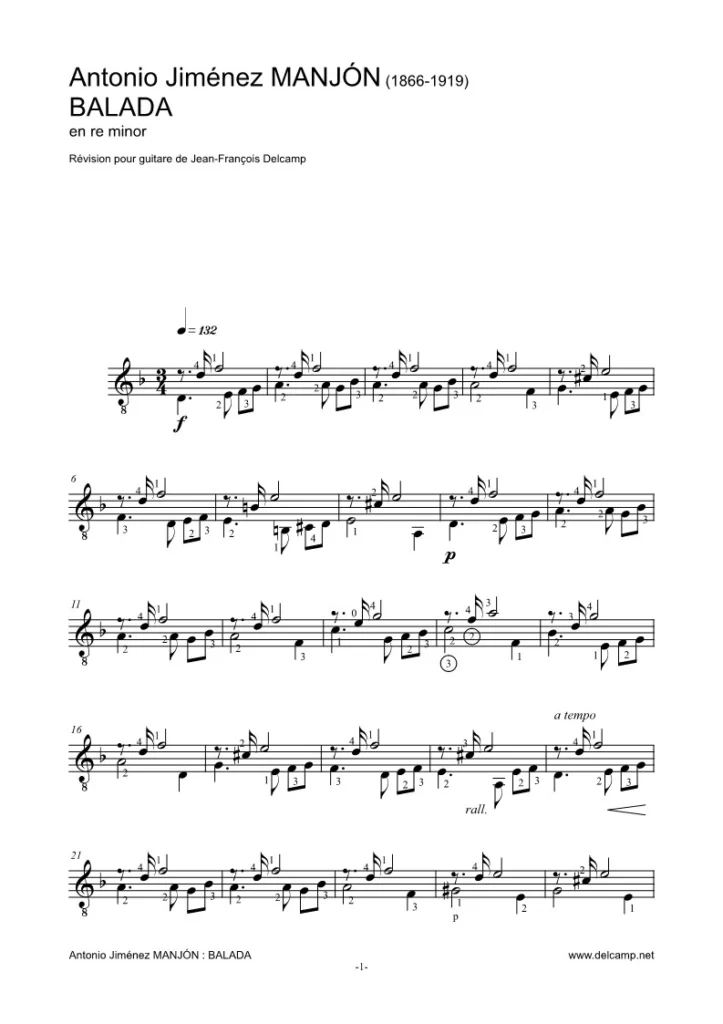
From 1860 to 1910 Barcelona replaced Paris as the hub of guitar music with Julian Arcas (1832-1882), José Ferrer y Esteve (1835-1916), Francisco Tárrega (1852-1909), Antonio Jiménez Manjón (1866-1919) and Miguel Llobet all being active.
From 1890 to 1940 Buenos Aires took over thanks to the arrival there of Antonio Jiménez Manjón and Miguel Llobet.
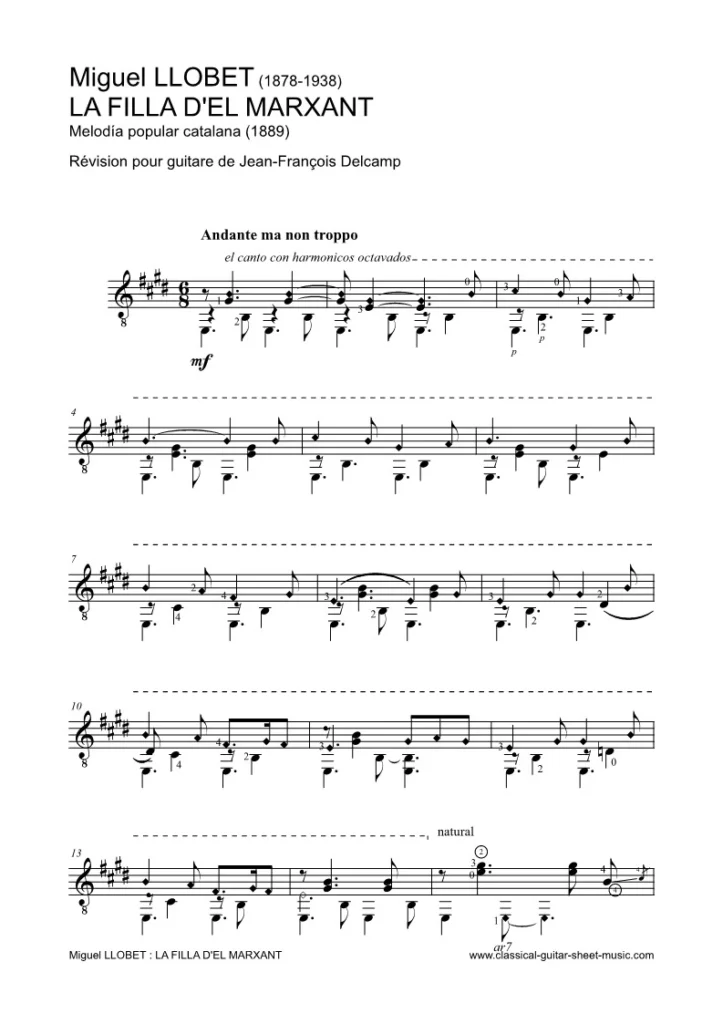
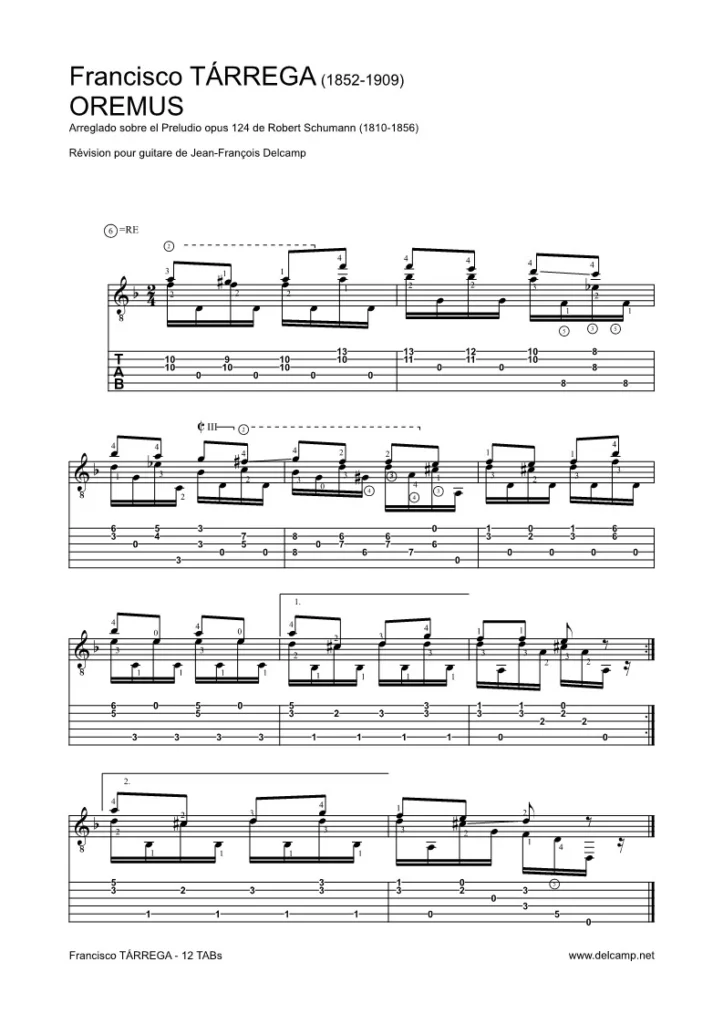
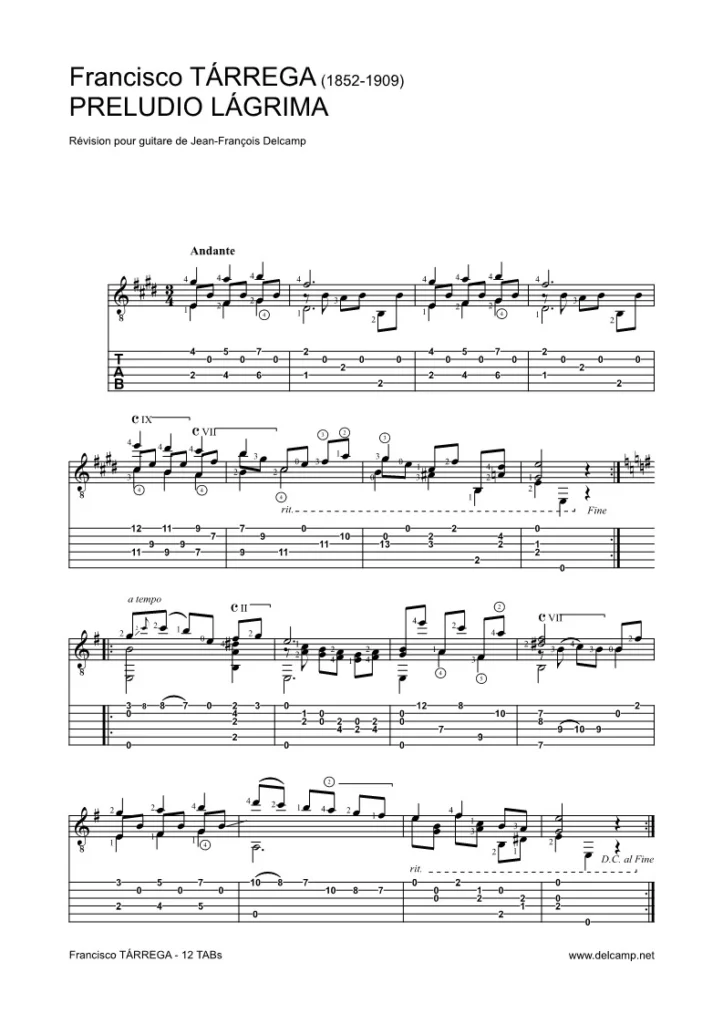
Modern Music for classical guitar (1900 to 1950)
South America boasted talents such as: Miguel Llobet (1878-1938), Julio Salvador Sagreras (1879-1942), Joao Guimarães (Pernambuco) (1883-1947), Agustín Barrios Mangoré (1885-1944) and Heitor Villa-Lobos (1887-1959).
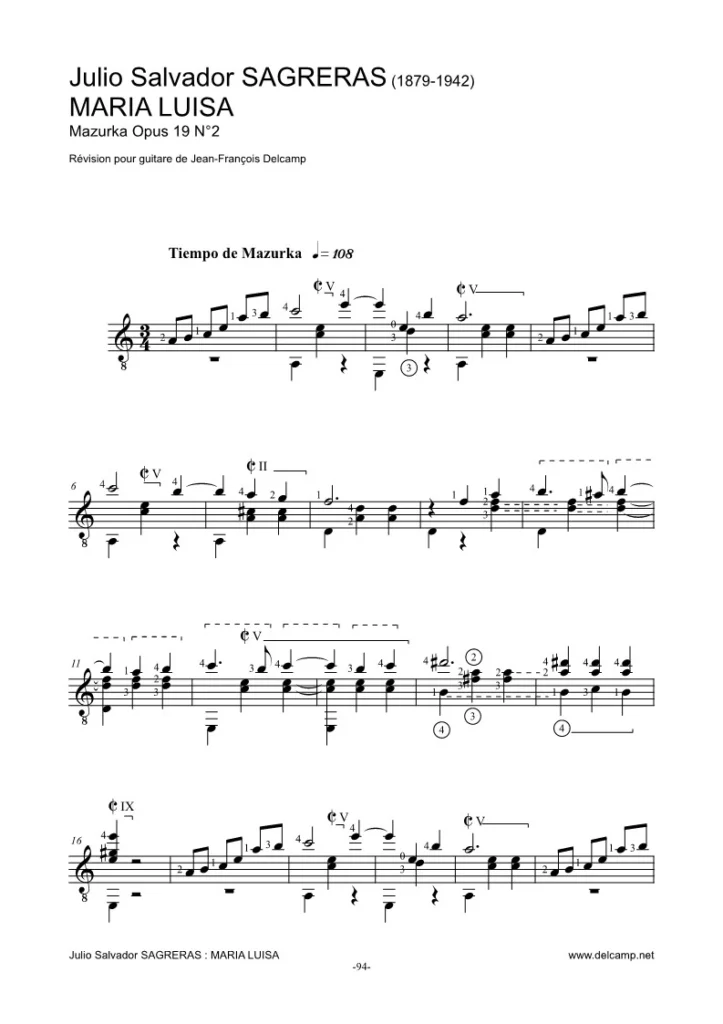
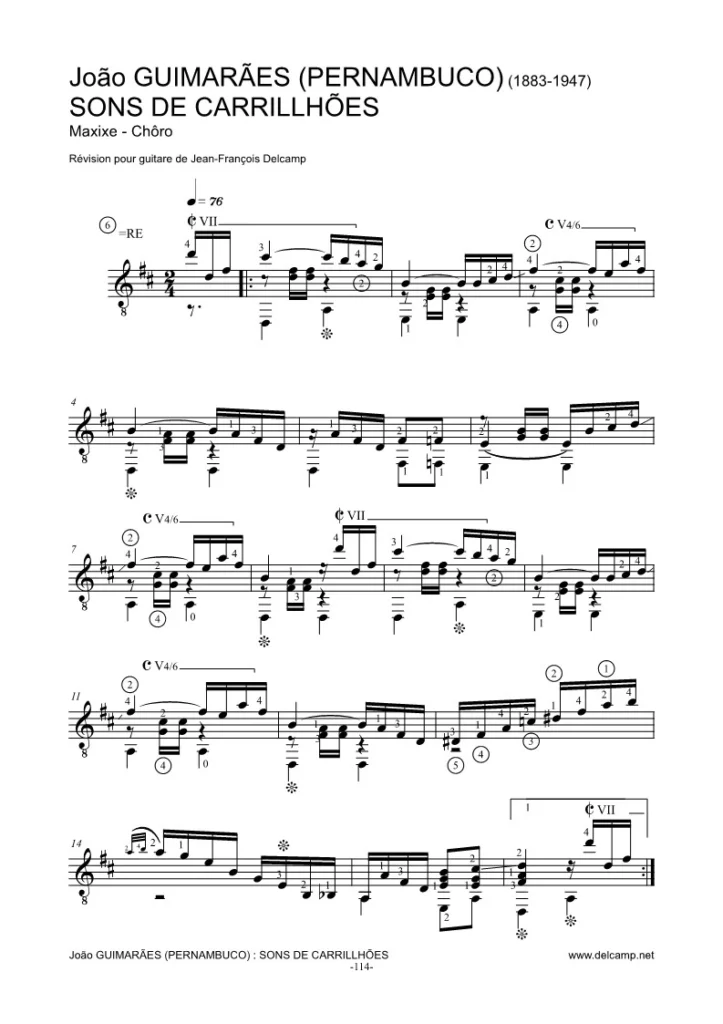
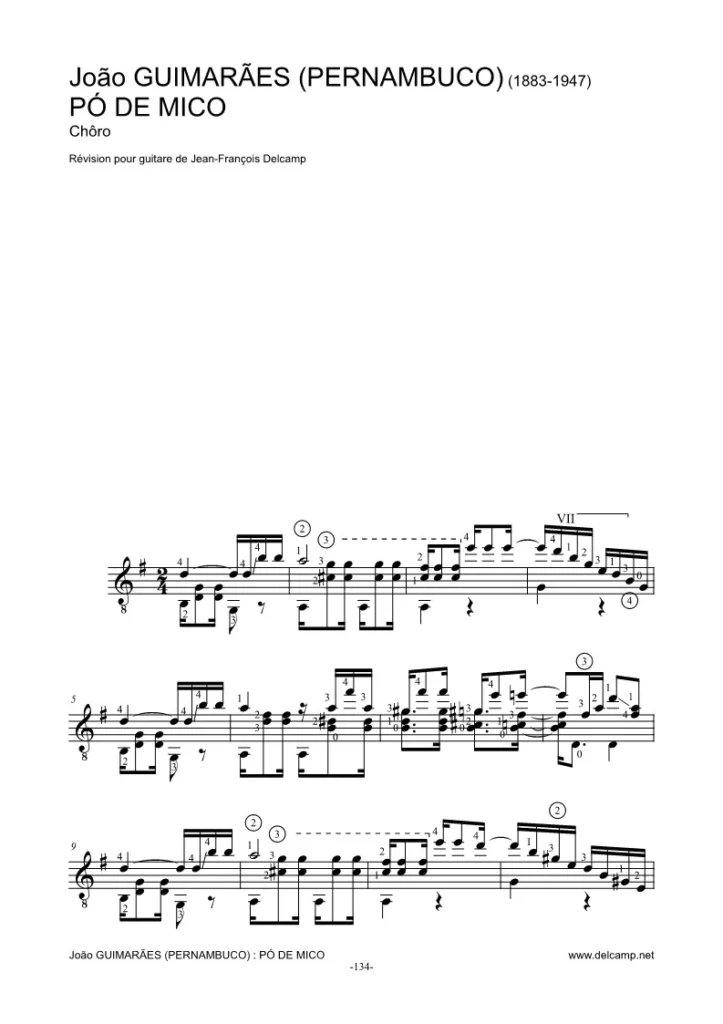
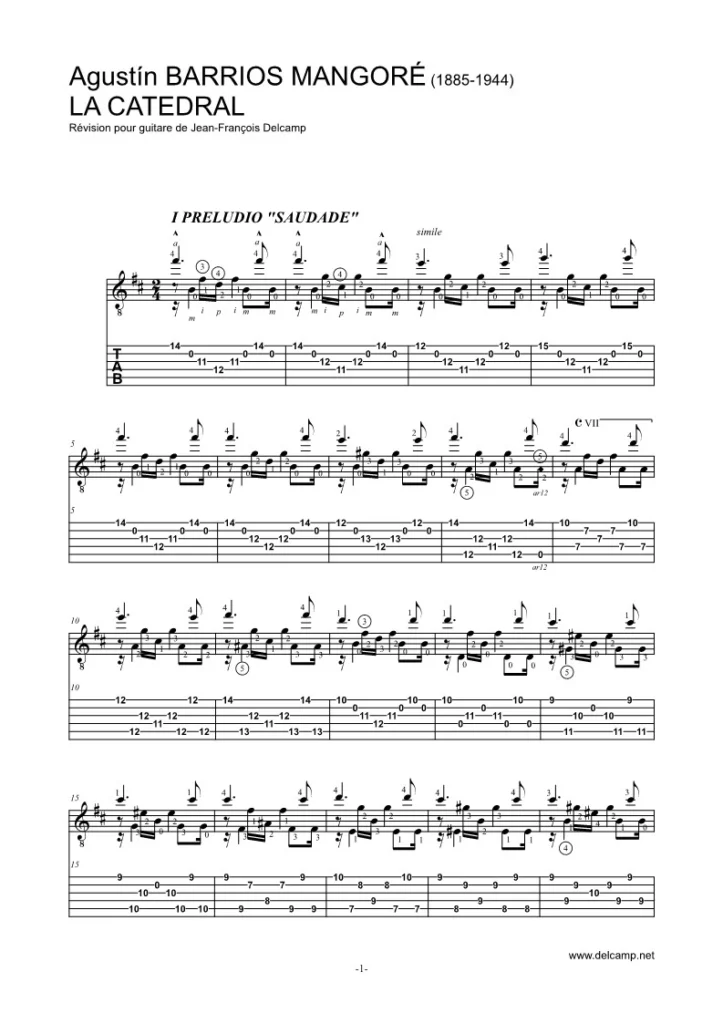
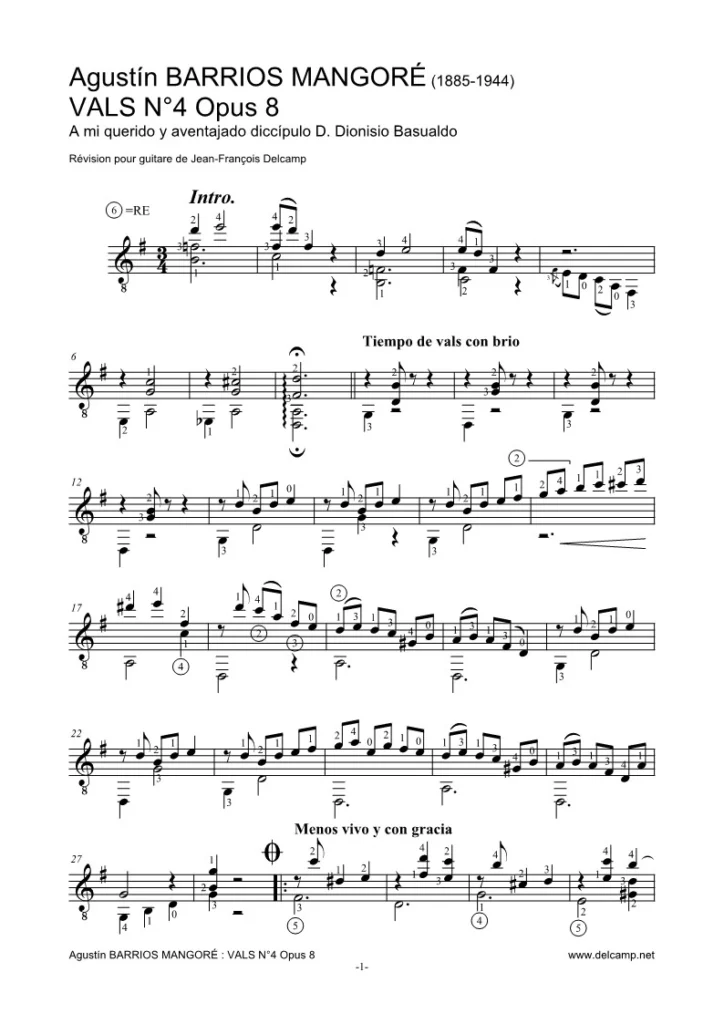
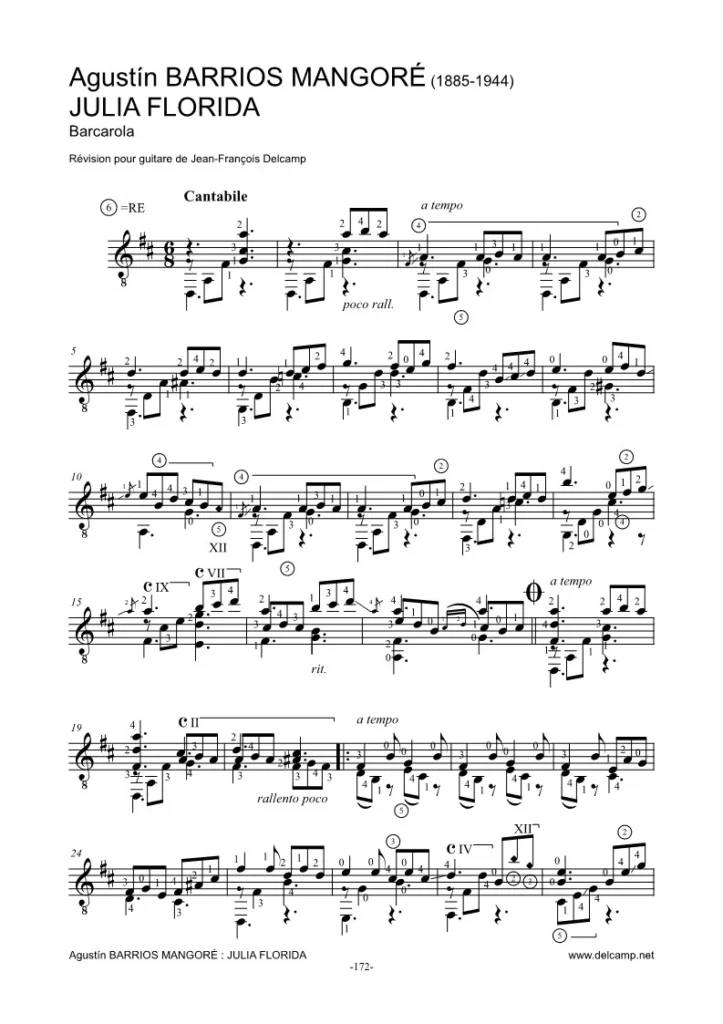
In the 1930s, Spain again became the center of the guitar with the composers Manuel de Falla (1886-1946), Joaquin Turina (1882-1949), Federico Moreno Torroba (1891-1982) and Joaquin Rodrigo (1901-1999), who wrote for the guitar without being guitarists themselves.
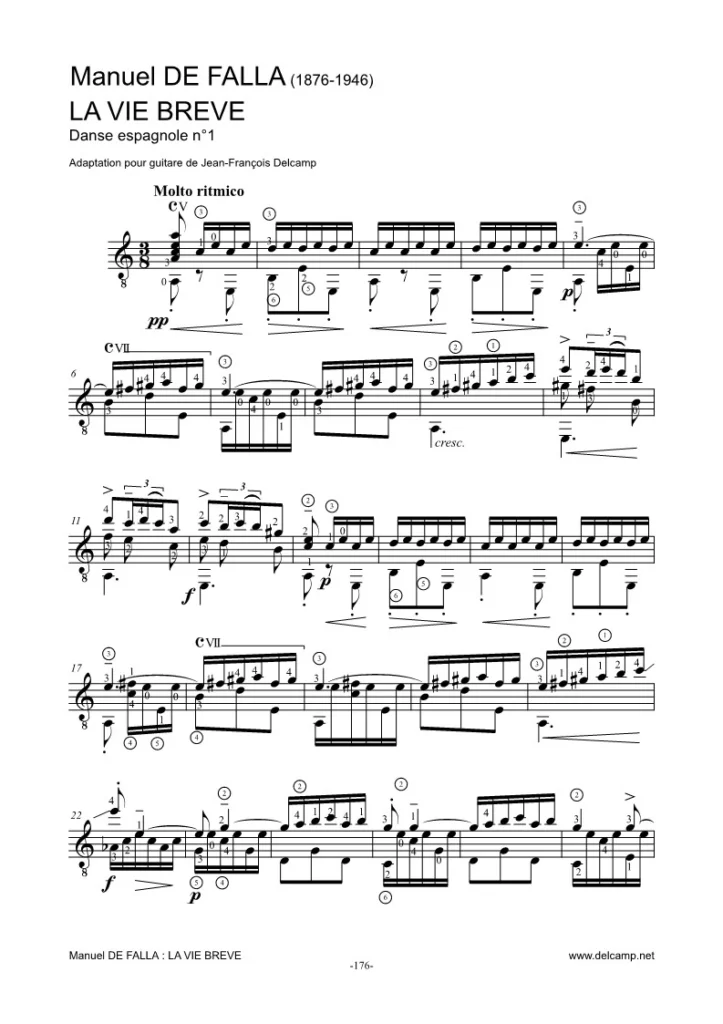
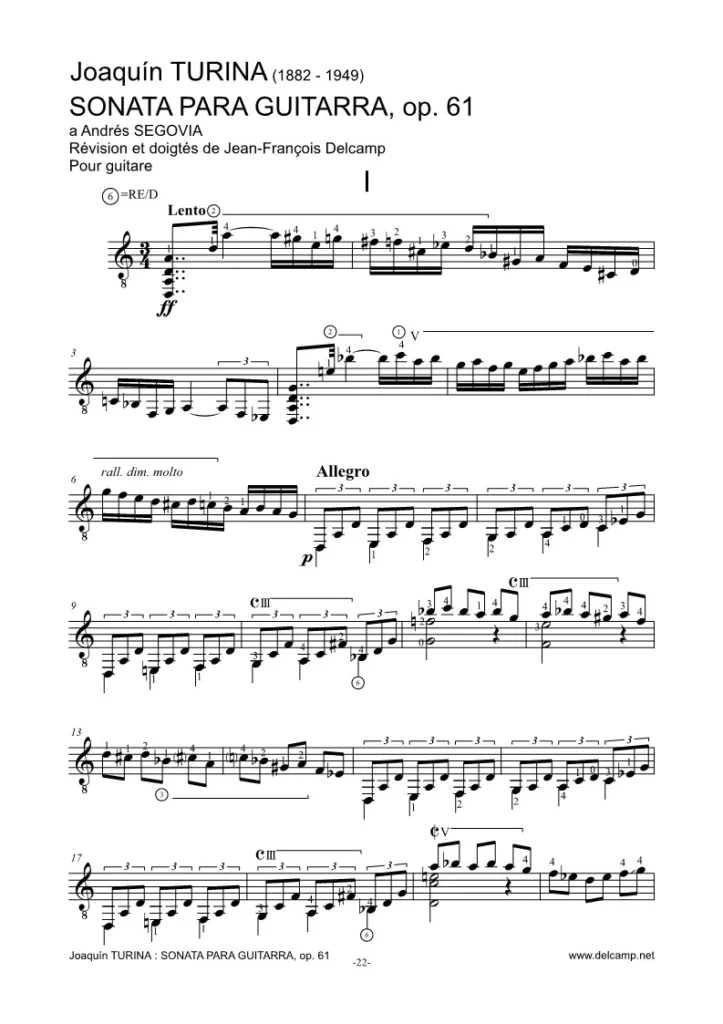
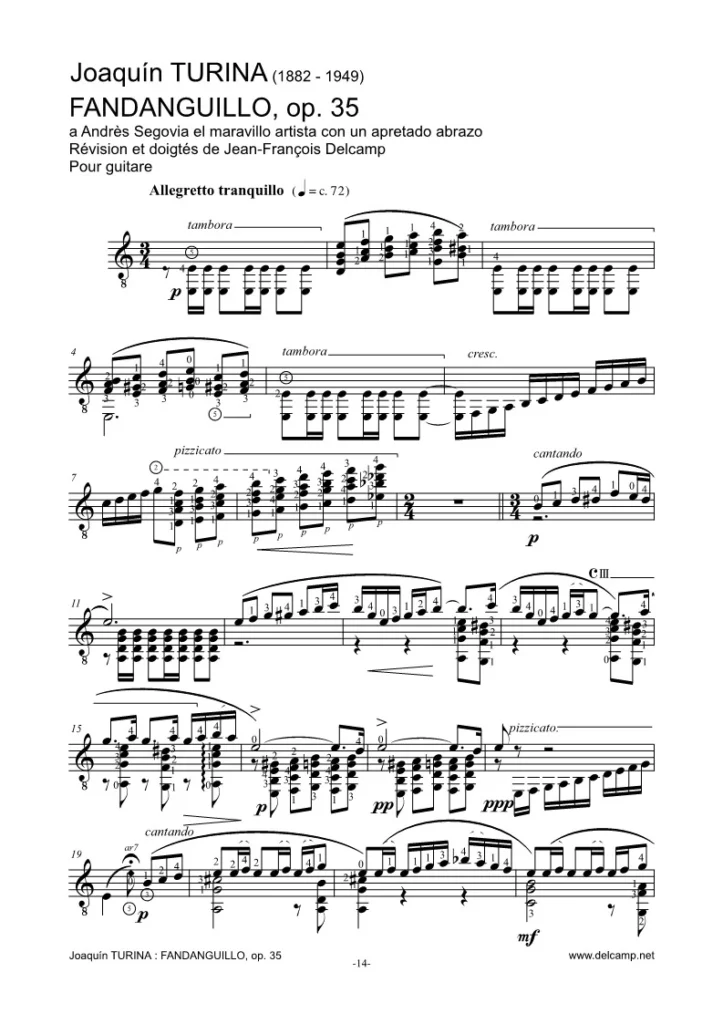
Manuel de Falla was the first non-guitarist composer to write for the guitar (1920), he opened the way to many composers who subsequently wrote for the guitar. These include:
Albert Roussel (1869-1937)
Segovia opus 29 (1925) Durand, Paris
Manuel Maria Ponce (1882-1948)
Tres canciones popular mexicanas. Schott’s Söhne, Mainz
Thème varié et final (1928). Schott’s Söhne, Mainz
Sonatina meridional (1932). Schott’s Söhne, Mainz
Variations sur Folia de España et Fugue (1932). Schott’s Söhne, Mainz
Concerto del Sul ( 1941). Peer international corporation, USA
Joaquin Turina (1882-1949)
Sevillana (1923).
Fandanguillo (1925).
Rafaga opus 53 (1930).
Sonata opus 61 (1932).
Hommage a Tárrega opus 69 (1932).
Manuel de Falla (1886-1946)
Homenaje a Debussy (1920).
Emilio Pujol (1886-1980)
Trois morceaux espagnols : Tonadilla, Tango, Guarija (1926?). Max Eschig, Paris
Heitor Villa-Lobos (1887-1959) :
Suite populaire Brésilienne (1912 – 1923). Max Eschig, Paris
Chôros n° 1 (1920). Max Eschig, Paris
12 études(1929). Max Eschig, Paris
5 Préludes (1940). Max Eschig, Paris
Federico Moreno Torroba (1891-1982)
Nocturno (1926?). Schott’s Söhne, Mainz
Suite Castellana (1926?). Schott’s Söhne, Mainz
Pièces caractéristiques (1931?) . Schott’s Söhne, Mainz
Madroños. Associated Music Publishers, USA
Sonatina (1965?). Editorial Cadencia, Madrid
Castillos de España (1970?) . Editorial Cadencia, Madrid
Franck Martin (1890-1974)
Quatre pièces brèves (1933). Universal Edition, Zürich
Mario Castelnuovo-Tedesco (1895-1968)
Capriccio diabolico opus 85 (1935). Ricordi, Milano
Tarentella opus 87b. Ricordi, Milano
Sonata opus 77. Schott’s Söhne, Mainz
Primo Concerto in D opus 99. Schott’s Söhne, Mainz
Joaquin Rodrigo (1901-1999)
Zarabanda lejana (1926). Joaquin Rodrigo, Madrid
En los trigales (1938). Joaquin Rodrigo, Madrid
Concierto de Aranjuez (1939). Joaquin Rodrigo, Madrid
Tiento antiguo (1947). Joaquin Rodrigo, Madrid
Contemporary music for classical guitar (post 1950)
Numerous composers have written for the guitar:
Heitor Villa-Lobos (1887-1959) :
Concerto pour guitare et petit orchestre (1951). Max Eschig, Paris
Francis Poulenc (1889-1963)
Sarabande (1960). Ricordi, Milano
Federico Monpou (1893-1987)
Suite Compostelana (1962). Salabert, Paris
Alexandre Tansman (1897-1986)
Danza Pomposa (1961?). Schott’s Söhne, Mainz
Suite “in modo polonico (1968). Max Eschig, Paris
Variations sur un thème de Scriabine (1972). Max Eschig, Paris
Joaquin Rodrigo (1901-1999)
Concerto “Fantasía para un gentilhombre” (1954). Schott’s Söhne, Mainz
Tres piezas españolas (1954). Schott’s Söhne, Mainz
Entre olivares (1956). Joaquin Rodrigo, Madrid
Invocación y danza (1961). Joaquin Rodrigo, Madrid
William Walton (1902-1983)
Five Bagatelles (1972). Oxford university press, Oxford
Guido Santórsola (1904-1994)
Preludio de la Suite Antigua. Ricordi, São Paulo
André Jolivet (1905-1974)
Deux études de concert (1963). Boosey & Hawkes, London
Vicente Asencio (1908-1979)
Suite de Homenajes : Sonatina, Elegía, Tango de la casada infiel. Schott Frère, Bruxelles
Benjamin Britten (1913-1976)
Nocturnal opus 70. Faber music limited, London
Maurice Ohana (1914-1992)
Tiento (1955). Billaudot, Paris
Si le jour paraît (1963). Billaudot, Paris
Antonio Lauro (1917-1986)
4 valses vénézuéliennes. Broekmans & van Poppel, Amsterdam
Reginald Smith-Brindle (1917-2003)
El polifemo de oro (1956). Schott, London
Variations “Ile de France” (1980).
Abel Carlevaro (1918-2001)
Campo (n°3 de “Preludios Americanos”). Barry Editorial, Buenos Aires
John W. Duarte (1919-2004)
English Suite, Opus 31 (1967?). Editions Novello, England
Sua cosa opus 52 (1972). Edizioni musicali Bèrben, Ancona
Astor Piazolla (1921-1992)
Cinco piezas (1981?). Edizioni musicali Bèrben, Ancona
Stephen Dodgson (1924-2013)
Partita for guitar (1963). Oxford university press, Oxford
Hans Werner Henze (1926-2012)
Drei tentos “Kammermusik 1958”. Schott’s Söhne, Mainz
Toru Takemitsu (1930-1996)
In the woods (1995). Schott Japan
Antonio Ruiz-Pipo (1934-1997)
Cancion y Danza n°1. Ediciones Musicales, Madrid
Léo Brouwer (1939)
Danza caracteristica (1957). Schott’s Söhne, Mainz
Micro piezas pour deux guitares (1958). Max Eschig, Paris
Tres apuntes (1959). Schott’s Söhne, Mainz
Elogio de la danza (1964). Schott’s Söhne, Mainz
Canticum (1968). Schott’s Söhne, Mainz
La espiral Eterna (1971). Schott’s Söhne, Mainz
El Decameron negro (1981). Editions Musicales Transatlantiques, Paris
Štěpán Rak (1945)
Temptation of the Renaissance (1984?). Chorus publication, Helsinki
Carlo Domeniconi (1947)
Koyunbaba op. 19. Editions Margaux
Nuccio d’Angelo (1955)
Due canzoni lidie (1984). Max Eschig, Paris
Roland Dyens (1955-2016)
Saudade n°3 (1980). Editions musicales Hortensia, Paris.
Tango en Skaï (1985). Henry Lemoine, Paris
Nikita Koshkin (1956)
The Prince’s Toys (1980). Gendai Guitar, Tokyo
Privacy policy
The Classical-guitar-sheet-music.com blog is concerned about compliance with the rules relating to the protection of personal data, and has therefore made this a priority. Accordingly, Classical-guitar-sheet-music.com has complied with the General Data Protection Regulation n°2016/679 (hereinafter referred to as “GDPR”) and the French Data Protection Act of January 6, 1978 in its latest version.
As the data controller, Classical-guitar-sheet-music.com undertakes to respect the confidentiality and security of your personal data, in accordance with this Personal Data Protection Policy, and to ensure that personal data is collected in a lawful, fair, transparent manner.
IDENTITY OF THE DATA CONTROLLER
The person responsible for processing personal data on the Site in the context of Classical-guitar-sheet-music.com / Users relations is :
Classical-guitar-sheet-music.com, Mr Jean-François Delcamp, 24 rue Maleyssie – 29200 Brest – France.
Classical-guitar-sheet-music.com may modify this Privacy Policy at any time. Any modification will take effect upon publication.
DATA COLLECTION AND PROCESSING
Classical-guitar-sheet-music.com may collect data when :
– you browse our blog,
– you register on our blog to read and publish articles and/or comments. Classical-guitar-sheet-music.com, as data controller, is likely to process all or part of the following data:
identification data:
– surname, first names, e-mail address.
– User connection data (IP addresses, connection logs) when the User uses his or her account.
– data relating to account management and security, in particular the e-mail address and password transmitted by the User.
We collect and use your personal information in order to provide you with a quality service and to simplify your access to our blog.
WHY IS THIS DATA COLLECTED?
The collection of your personal data is necessary for Classical-guitar-sheet-music.com in order to :
– Put comments and content posted on the blog online,
– Allow you to create and access a personal space on our site
– Answer your questions
– Fight against fraud
– Subject to your consent, this data also enables us to:
– Produce sales statistics or measure the performance of our communications
– Produce marketing analyses and tools (e.g. scores, segmentation, etc.),
CONSENT
When registering on the blog, the user fills in various forms and communicates various personal data concerning him/her in order to benefit from all accessible services.
By spontaneously communicating their personal data, users expressly consent to their data being collected and processed by Classical-guitar-sheet-music.com for the purposes of which they have been informed.
Users browsing the blog also consent to their connection data being collected in order to facilitate their browsing and use of the various services offered.
DATA SHARING WITH OTHER COMPANIES
Your personal data will remain the exclusive property of Classical-guitar-sheet-music.com. We undertake not to pass on your personal data to third parties (whether for payment or free of charge).
Your personal data may be shared with Classical-guitar-sheet-music.com’s subcontractors in order to :
– Display our partners’ advertising campaigns
– Carry out statistics and geomarketing
– Improve navigation on the blog if you accept the use of cookies (If you choose to block our cookies, certain blog functionalities and navigation facilities will be deactivated. If you choose to delete all cookies, your user experience will be greatly affected and your browsing preferences will be erased).
– Invite you to events organized by Classical-guitar-sheet-music.com.
– Management of Site hosting and maintenance services.
– Control of Classical-guitar-sheet-music.com’s activities (departments responsible for internal control procedures, etc.).
HOW LONG WILL YOUR PERSONAL DATA BE KEPT?
Classical-guitar-sheet-music.com keeps the personal data of its visitors and members only for as long as is necessary for the purposes of the processing carried out, or for as long as is required by law.
Cookies are kept for a maximum of thirteen (13) months.
Classical-guitar-sheet-music.com distinguishes between visitors and customers in order to determine the appropriate retention periods.
Visitors’ personal data is kept for a few hours after the last positive and explicit contact from the visitor.
Members’ personal data is kept only as long as it is required for the purpose for which it was collected. It is deleted as soon as the member exercises his or her right of deletion and forgetting.
Contractual data is kept and archived for the time required to meet legal obligations, and/or for the duration of applicable statutes of limitation.
Individuals may also define directives concerning the management of their personal data and its retention, deletion and communication after their death. In the absence of specific instructions from the deceased during his or her lifetime, the heirs may only exercise the rights of deletion and oblivion.
WHAT ARE YOUR RIGHTS AND HOW TO EXERCISE THEM?
What are your rights?
In accordance with current regulations on the protection of personal data, you can :
– Access all your data (subject to certain restrictions),
– Rectify or update your data if it is inaccurate, incomplete or out of date.
– Request the portability of your data,
– Object to the processing of your data,
– Request the deletion of your data. This is not an absolute right, as we may be obliged to retain your personal data for legal, legitimate or contractual reasons,
– Request that we restrict the processing of your data.
How to exercise your rights
You can exercise your rights as described above at any time by making a request on this blog, by posting your request as a comment at the bottom of this page.
We may verify your identity before processing your request.
A confirmation will be sent to you within a maximum of two months from the date of receipt of your request.
SECURITY
Classical-guitar-sheet-music.com declares that it complies with applicable data security and confidentiality standards (Cf. Article 34 of the French Data Protection Act and Article 32 of the RGPD).
In this respect, Classical-guitar-sheet-music.com takes the necessary precautions, with regard to the nature of the data and the risks presented by the processing, to preserve the security of the data and, in particular, to prevent it from being distorted, damaged, or accessed by unauthorized third parties.
How do we use cookies on this blog?
We use files called cookies on the Classical-guitar-sheet-music.com blog to improve its performance and enhance your user experience. By using the Classical-guitar-sheet-music.com blog you agree that we may place these types of files on your device.
What are cookies?
Cookies are small text files that a website can store on your computer or mobile device, when you visit a site or one of its pages for the first time.
There are many functions that a cookie can be used for. For example, a cookie will help the site or another site recognize your device the next time you visit. The Classical-guitar-sheet-music.com blog uses the term “cookies” in its privacy policy to refer to all files that collect information in this way.
Some cookies contain personal information – for example, if you click on “Remember me” when logging in, a cookie will store your username. Most cookies do not collect personally identifiable information, but collect more general information such as how users arrived and use Classical-guitar-sheet-music.com blog.
What kind of cookies does the Classical-guitar-sheet-music.com blog use?
Cookies can perform several different functions:
Functionality cookies
These cookies remember the choices you make to improve your user experience.
The Classical-guitar-sheet-music.com blog may also allow third parties to use cookies in the above categories. For example, like many sites, we may use Google Analytics to help us evaluate our website traffic.
Essential cookies
Certain cookies are essential for the operation of the Classical-guitar-sheet-music.com blog. These cookies enable the services you have specifically requested to function.
Performance cookies
These cookies may collect anonymous information about the pages visited. For example, we may use performance cookies to keep track of which pages are most popular.
Can a blog user block cookies?
To find out how to manage the cookies you allow, see your browser’s help section or your mobile device’s manual – or you can visit the site below, which gives detailed information on how to manage, control or delete cookies.
http://www.allaboutcookies.org/fr/
Please remember that if you choose to disable cookies, you may find that some sections of the Classical-guitar-sheet-music.com blog will not function correctly.
Cookies on the Classical-guitar-sheet-music.com blog from social networking sites
The Classical-guitar-sheet-music.com blog may have links to social networking sites (e.g. facebook, twitter or YouTube). These sites may also place cookies on your device and the Classical-guitar-sheet-music.com blog does not manage how they use their cookies, so the Classical-guitar-sheet-music.com blog suggests you check their sites to see how they use cookies.
Our privacy policy and partners:
– Third-party suppliers, including Google and Google Analytics, use cookies to serve ads based on visitors’ previous visits to our Classical-guitar-sheet-music.com website or other pages.
– By placing advertising cookies on your hard drive, Google and its partners are able to tailor ads to our visitors based on their browsing experience on our website and/or other websites.
– Users can choose to disable personalized advertising in the Ad Settings. You can also disable third-party cookies for personalized advertising by visiting https://youradchoices.com/.
CLASSICAL-GUITAR-SHEET-MUSIC.COM makes no guarantee that the files provided for download, viewing or streaming on CLASSICAL-GUITAR-SHEET-MUSIC.COM are public domain in your country and assumes no legal responsibility or liability of any kind for their copyright status. Please obey the copyright laws of your country and consult the copyright statute itself or a qualified IP attorney to verify whether a certain file is in the public domain in your country or if downloading a copy constitutes fair use. By clicking any link on this site including the link below, you acknowledge that you understand and agree to the above disclaimer. Close this window or leave this site if you do not agree.