Turina, Joaquín
Classical guitar sheet music in free PDF. Delcamp Editions with fingerings
PDF : Joaquín Turina – Complete works for guitar with facsimiles – Revised by Jean-François Delcamp – Biography by Julien Bambaggi (80 pages, 4.6 MB.)
Sevillana, op. 29, (1923)
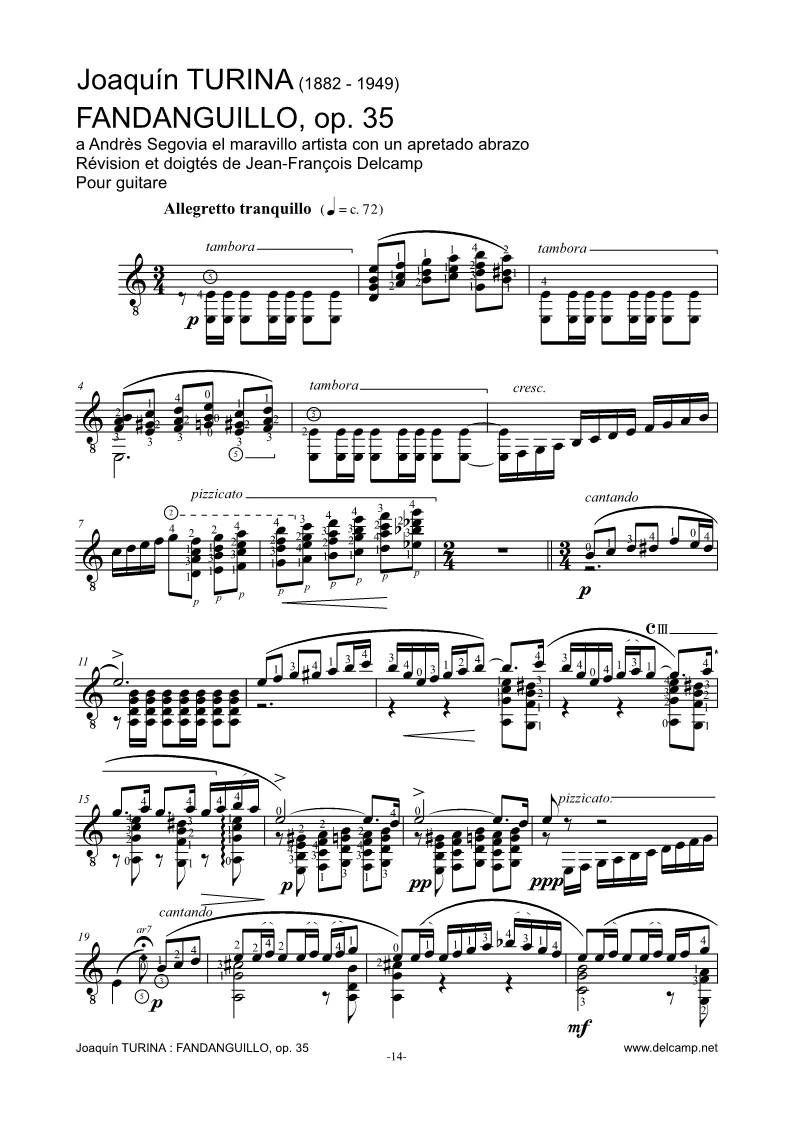
Fandanguillo, op. 36, (1925)
Ráfaga, op. 53, (1930)
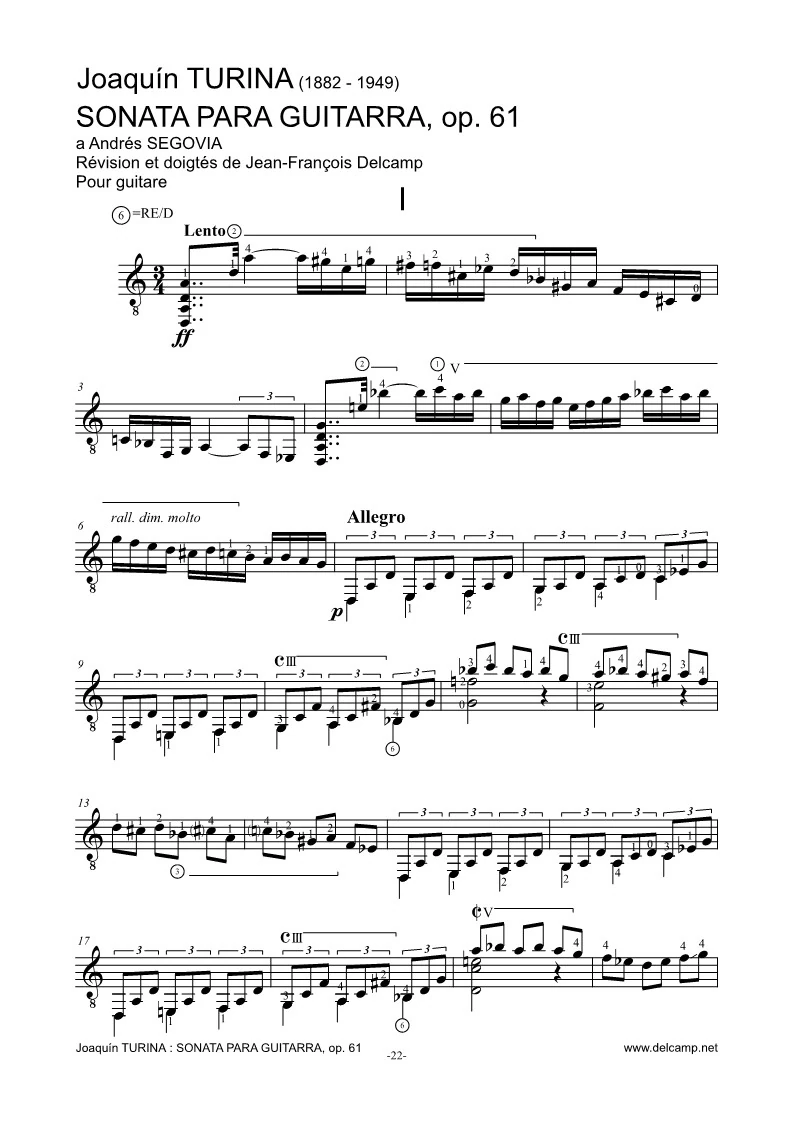
Sonata en ré mineur, op. 61, (1932)
Homenaje a Tárrega, op. 69, (1932).
Facsimiles of the original manuscripts are included at the end of the volume. Messrs. David Norton, David J. Buch, Bernard Corneloup, Denis Paradis, Eric Bilange, and Philippe Vilo assisted in this edition by collecting the facsimiles and proofreading the drafts before publication.
Joaquín Turina (1882-1949) in Spanish music
Joaquín Turina is, along with Enrique Granados, Isaac Albéniz and Manuel de Falla, one of the “great” Spanish composers of the first half of the twentieth century, even if he is less performed, or at least less known internationally, than the last three. But, while they composed almost nothing for the guitar – only Manuel de Falla composed a single piece for guitar, his Homenaje for the Tombeau de Claude Debussy – Turina’s work for guitar, which Jean-François Delcamp makes available to all through this edition, is relatively substantial. He is therefore one of the few “generalist” composers to have enriched the guitar repertoire.
Joaquín Turina was born in Seville, Andalusia, in December 1882, and died in Madrid in January 1949, at the age of 66. Deeply imbued with the conservative Catholicism that prevailed among the Andalusian bourgeoisie and petty bourgeoisie at the time – at the age of 16 he had joined the “Confraternity of Jesus of the Passion” – his initial musical training was quite far from Spanish music: the musical education he received focused mainly on German music and Italian opera – his first concerts as a pianist featured German musicians.
He went to Madrid in 1902 to study medicine, but gave it up to devote himself to music. The following year, at the age of 23, he was admitted to the Schola Cantorum in Paris where he continued his musical training, especially with Vincent d’Indy. In Paris, he rubbed shoulders with Debussy, Ravel, as well as the prolific and controversial Florent Schmitt. This proximity has given rise to music that is far removed from Spanish inspiration, such as his piano quintet in G minor, opus 1, composed in 1907, very classical in style and whose chromaticism recalls the music of César Franck, Vincent d’Indy’s teacher. Turina himself recounted the following anecdote about this. Attending the premiere of this quintet, Albéniz leaned over to his neighbour, a fellow Spaniard, and asked if the author was “English” – in Spain, at the time, anyone non-Hispanic was called “English”, especially tourists, particularly in Andalusia. “No, sir, he is a Sevillian,” replied the neighbor. At the end of the concert, the three met in a Parisian brasserie. This is how Turina first met Isaac Albéniz and Manuel de Falla, the former advising Turina to stop writing “French” music and look for inspiration in Spanish music. Turina describes the meeting as a radical turning point. From then on, he mixed Andalusian inspiration with the rigor of writing he had learned from d’Indy.
The following year, in 1908, Turina successively produced a piano suite, Sevilla, as well as a Spanish Sonata for violin and piano, whose Andalusian accents from the very first bars leave no doubt as to the direction taken by Joaquín Turina. The pieces followed one another: Romantic Sonata on a Spanish Theme for piano (1910), Ricones sevillanos (1911), Escena andaluza for piano (1912 and 1913), La procesión del Rocio (1913), a symphonic poem with Andalusian accents and slightly jazzy, described as a “luminous fresco” by Claude Debussy, Three Andalusian Dances (1913), Cuentos de España (including Elcamino de la Alhambra and En los jardines de Murcia orchestrated by Stéphane Chapelier), Danzas fantasticas, Sinfonia sevillana, Jardines de Andalucía, La Oración del torero, originally composed for four lutes and arranged for string orchestra. And many other pieces. Turina performed in all genres: piano music, chamber music, orchestral music, incidental music, operas. Recognized in Spain, he won the National Prize for Composition in 1926 before being appointed professor of composition at the Madrid Conservatory in 1931. He remained so and enjoyed numerous official honors until his death in Madrid in 1949.
The revolt that responded to General Franco’s coup d’état in 1936 and the ensuing civil war deeply divided Spanish intellectuals and artists. Families were torn – think of the two guitarist and composer brothers Eduardo and Regino Sáinz de la Maza –, friendships shattered: while his friend Manuel de Falla refused to join Franco’s Spain until his death despite the regime’s numerous attempts, Joaquín Turina sided with Franco, describing his coup d’état as a “Glorious national uprising”. A national uprising which, to take just one literary and musical example, resulted in the execution on August 19, 1936, in the vicinity of Granada, of the writer, composer and pianist Federico Garcia Lorca, who, for his part, admired the “sentimental and sensual triumphal arch” of Turina’s orchestral music. But Turina was certainly not alone.
The Guitar Work
Under the friendly pressure of Andrés Segovia, who was performing all over the world by the late 1920s, Turina composed for the guitar a body of work which, although less important in volume than that of guitarist composers such as Sor or Tárrega, made him join the very restricted club of generalist composers who had composed for the guitar like this other Spaniard, Federico Moreno Torroba, specialized in the genre of zarzuelas – a Spanish theatrical and lyrical genre born in the seventeenth century, close to what will later be the opéra-comique in France – very little or not at all approached by Turina, Falla or Albéniz.
Julien Bambaggi, 2024 05 03
Personally, Turina has accompanied me since the beginning of my journey as a guitarist. I performed the Fandanguillo, Op. 36, to enter the “advanced” class (equivalent to the current third cycle) at the Conservatoire de Région de Saint-Maur-des-Fossés (France). Later, I played the Sonata, Op. 61, at the international competition of UFAM (Union of Women Artists Musicians, Paris), where I won first prize. I also performed Ráfaga and Homenaje a Tárrega. Sevillana was a piece I had never played until now; it was through the inspiration provided by this publication that I finally approached this work.
Jean-François Delcamp